My first sales event on Grey and Slate, Haberdashers!

My first sales event on Grey and Slate™!

All shirts 25% off thru 02 Dec for Etsy’s Black Friday promo.

Hand-drawn circuits and maker references (NE555, op-amps, vintage chips).

Help me hit 20 sales before year-end.

Please share this with folks who like shirts designed for hardware nerds. 🙏

For context:
I’ve been posting a new design almost daily since May.

I’m up to 183 listings, 3 sales, and still learning.

Every design is made by me. Many with hand-drawn illustrations of actual circuits and chips that makers will recognize.

I’d appreciate any shares to makers and hardware folks!

Pause for station identification

Yay. Another year, another pause for station identification.

Me
Who am I? I’m Charlie Schick. I’m passionate about exploring how the intersection of bits and atoms help us tell stories of our physical-digital-sublime world. I also advise companies on product design, business strategy, and new market opportunities. I’m a recovering PhD, too, and proudly ex-IBM, -Boston Children’s, -Nokia.

By day
I am Senior Advisor, Invest in Finland, at Business Finland, advising US organizations on business and investment opportunities in Finland. I am focused, as has been my long-time interest, on opportunities in digital health and life sciences.

By night
My main hobbies revolve around embedded electronics, 3D printing, and making in general. Many of my projects tend to be making the intangible tangible, such as ‘what does dementia look like?’ or ‘can we encode immortality in a dying chip?’ I post most of my projects to this blog, so do keep coming back to see what I’m up to. Oh, the places we’ll go.

Grey and Slate, Haberdashers
One recent development has been illustrating maker-inspired designs, which I currently make available on shirts thru my Etsy store, Grey and Slate™. You can read more about my journey here on this blog, on Bluesky (@greyandslate.bsky.social), and in my shop’s about section.

Because I can’t stop
For a very long time, I’ve been sharing my experience, insights, and exploits, especially through writing for and speaking to large audiences and engaging with others in stimulating conversations, including the office of CxOs. Let me know how I can help in this capacity (tho most likely through LinkedIn).

And of course, my standard disclaimer
(my usual riff off of an ancient Cringely disclaimer)
Everything I write here on this site is an expression of my own opinions, NOT of any of my customers or anyone I work for, especially the Finnish government. If these were the opinions of my customers or the Finnish government, the site would be under their name and, for sure, the writing and design would be much more professional. Likewise, I am an intensely trained professional writer 😛, so don’t expect to find any confidential secret corporate mumbo-jumbo being revealed here.

If you have ideas or projects that you think I might be interested in, please contact me, Charlie Schick, at firstname.lastname@molecularist.com or via my profile on LinkedIn.

Yes, you can find me on Twitter. I use it more to follow an amazing community of makers, to be marveled by their creativity, commentary, and caring; though, do say ‘hi’ if you swing by. Left Twitter for good 15feb2023, after 16 years. I got back to the socials, recently, hopping on Bluesky on 09nov25, mostly to reconnect with the maker community and to share my designs. And I am happy I did.

Image “Hand-drawn 6581 chip, large, with MOS SID text” adapted from “Two variants of ‘SID’ sound chips” by Taras Young underCC BY-SA 4.0 . “Hand-drawn 6581 chip, large, with MOS SID text” © 2025 by Grey and Slate, Haberdashers™, is licensed under CC BY-SA 4.0. You can get this image on a shirt here.

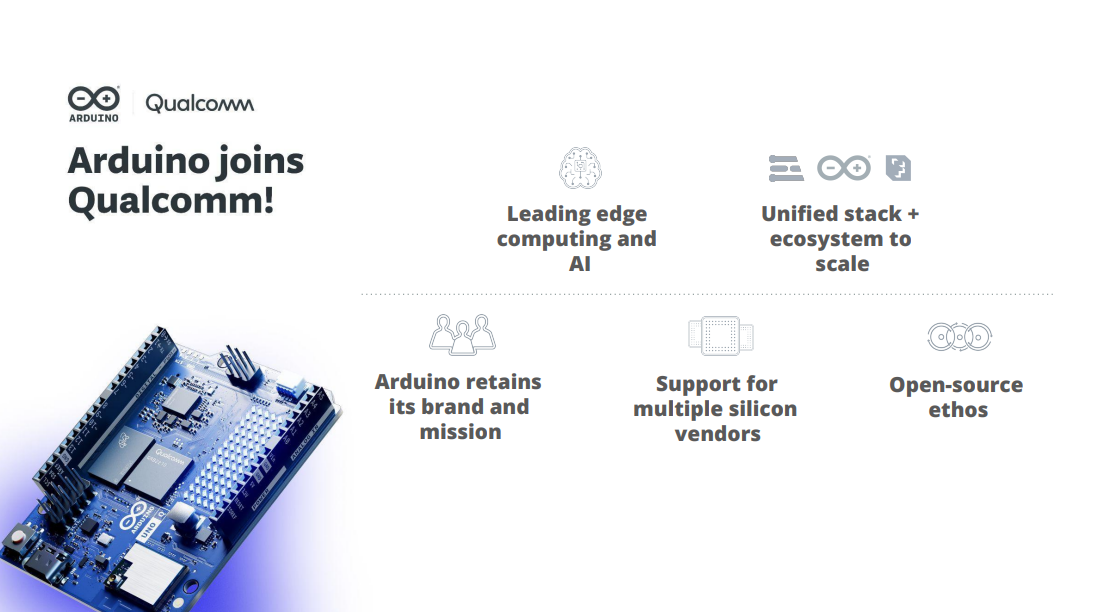
Did Qualcomm kill Arduino for good?

Six weeks ago, Qualcomm acquired Arduino. The maker community immediately worried that Qualcomm would kill the open-source ethos that made Arduino the lingua franca of hobby electronics.

This week, Arduino published updated terms and conditions and a new privacy policy, clearly rewritten by Qualcomm’s lawyers. The changes confirm the community’s worst fears: Arduino is no longer an open commons. It’s becoming just another corporate platform.

Here’s what’s at stake, what Qualcomm got wrong, and what might still be salvaged, drawing from community discussions across maker forums and sites.

What changed?
The new terms read like standard corporate boilerplate: mandatory arbitration, data integration with Qualcomm’s global ecosystem, export controls, AI use restrictions. For any other SaaS platform, this would be unremarkable.

But Arduino isn’t SaaS. It’s the foundation of the maker ecosystem.

The most dangerous change is Arduino now explicitly states that using their platform grants you no patent licenses whatsoever. You can’t even argue one is implied. 

This means Qualcomm could potentially assert patents against your projects if you built them using Arduino tools, Arduino examples, or Arduino-compatible hardware.

And here’s the disconnect, baffling makers. Arduino’s IDE is licensed under AGPL. Their CLI is GPL v3. Both licenses explicitly require that you can reverse engineer the software. But the new Qualcomm terms explicitly forbid reverse engineering “the Platform.”

What’s really going on?
The community is trying to figure out what is Qualcomm’s actual intent. Are these terms just bad lawyering with SaaS lawyers applying their standard template to cloud services, not realizing Arduino is different? Or is Qualcomm testing how much they can get away with before the community revolts? Or is this a first step toward locking down the ecosystem they just bought?

Some people point out that “the Platform” might only mean Arduino’s cloud services (forums, Arduino Cloud, Project Hub) not the IDE and CLI that everyone actually uses.

If that’s true, Qualcomm needs to say so, explicitly, and in plain language. Because library maintainers are likely wondering whether contributing to Arduino repos puts them at legal risk. And hardware makers are questioning whether “Arduino-compatible” is still safe to advertise. 

Why Adafruit’s alarm matters
Adafruit has been vocal about the dangers of this acquisition. Some dismiss Adafruit’s criticism as self-serving. After all, they sell competing hardware and promote CircuitPython. But that misses who Adafruit is.

Adafruit has been the moral authority on open hardware for decades. They’ve made their living proving you can build a successful business on open principles. When they sound the alarm, it’s not about competition, it’s about principle.

What they’re calling out isn’t that Qualcomm bought Arduino. It’s that Qualcomm’s lawyers fundamentally don’t understand what they bought. Arduino wasn’t valuable because it was just a microcontroller company. It was valuable because it was a commons. And you can’t apply enterprise legal frameworks to a commons without destroying it.

Adafruit gets this. They’ve built their entire business on this. That’s why their criticism carries weight.

What Qualcomm doesn’t seem to understand
Qualcomm probably thought they were buying an IoT hardware company with a loyal user base. 

They weren’t. They bought the IBM PC of the maker world.

Arduino’s value was never just the hardware. Their boards have been obsolete for years. Their value is the standard. 

The Arduino IDE is the lingua franca of hobby electronics. 

Millions of makers learned on it, even if they moved to other hardware. ESP32, STM32, Teensy, Raspberry Pi Pico – none of them are Arduino hardware, but they all work with the Arduino IDE.

Thousands of libraries are “Arduino libraries.” Tutorials assume Arduino. University curricula teach Arduino. When you search “how to read a sensor,” the answer comes back in Arduino code.

This is the ecosystem Qualcomm’s lawyers just dropped legal uncertainty onto.

If Qualcomm’s lawyers start asserting control over the IDE, CLI, or core libraries under restrictive terms, they will poison the entire maker ecosystem. Even people who never buy Arduino hardware are dependent on Arduino software infrastructure.

Qualcomm didn’t just buy a company. They bought a commons. And now they inadvertently are taking steps that are destroying what made it valuable.

What are makers supposed to do?
There has been some buzz of folks just leaving the Arduino environment behind. But Arduino IDE alternatives such as PlatformIO and VSCode are not in any way beginner friendly. If the Arduino IDE goes, then there’s a huge problem. 

I remember when Hypercard ended. There were alternatives, but none so easy. I don’t think I really coded again for almost 20 years until I picked up the Arduino IDE (go figure).

If something happens to the Arduino IDE, even if its development stalls or becomes encumbered, there’s no replacement for that easy onboarding. We’d lose many promising new makers because the first step became too steep.

The institutional knowledge at risk
But leaving Arduino behind isn’t simple. The platform’s success depends on two decades of accumulated knowledge, such as countless Arduino tutorials on YouTube, blogs, and school curricula; open-source libraries that depend on Arduino compatibility; projects in production using Arduino tooling; and university programs built around Arduino as the teaching platform

All of these depend on Arduino remaining open and accessible.

If Qualcomm decided to sunset the open Arduino IDE in favor of a locked-down “Arduino Pro” platform, or if they start asserting patent claims, or if uncertainty makes contributors abandon the ecosystem, all that knowledge becomes stranded.

It’s like Wikipedia going behind a paywall. The value isn’t just the content, it is the trust that it remains accessible. Arduino’s value isn’t just the code, it’s the trust that the commons would stay open.

That trust is now gone. And once lost, it hard to get back.

Why this happened (but doesn’t excuse it)
Let’s be fair to Qualcomm, their lawyers were doing their jobs.

When you acquire a company, you standardize the legal terms; add mandatory arbitration to limit class action exposure; integrate data systems for compliance and auditing; add export controls because you sell to defense contractors; prohibit reverse engineering because that’s in the template.

For most acquisitions, this is just good corporate hygiene. And Arduino, now part of a megacorp, faces higher liabilities than it did as an independent entity.

But here’s what Qualcomm’s lawyers missed: Arduino isn’t a normal acquisition. The community isn’t a customer base, it’s a commons. And you can’t apply enterprise SaaS legal frameworks to a commons without destroying what made it valuable.

This is tone-deafness, not malice. But the outcome is the same. A community that trusted Arduino no longer does.

Understanding why this happened doesn’t excuse it, but it might suggest what needs to happen next.

What should have happened and how to still save it
Qualcomm dropped legal boilerplate on the community with zero context and let people discover the contradictions themselves. That’s how you destroy trust overnight.

Qualcomm should have announced the changes in advance. They should have given the community weeks, not hours, to understand what’s changing and why. They should have used plain-language explanations, not just legal documents.

Qualcomm can fix things by explicitly carving out the open ecosystem. They should state clearly that the terms apply to Arduino Cloud services, and the IDE, CLI, and core libraries remain under their existing open source licenses.

We’d need concrete commitments, such as which repos stay open, which licenses won’t change, what’s protected from future acquisition decisions. Right now we have vague corporate-speak about “supporting the community.” 

Indeed, they could create some structural protection, as well, by putting IDE, CLI, and core libraries in a foundation that Qualcomm couldn’t unilaterally control (think the Linux Foundation model).

Finally, Qualcomm might wish to establish some form of community governance with real representation and real power over the tools the community depends on.

The acquisition is done. The legal integration is probably inevitable. But how it’s done determines whether Arduino survives as a commons or dies as just another Qualcomm subsidiary.

What’s next?
Arduino may be the toolset that made hobby electronics accessible to millions. But that maker community built Arduino into what it became. Qualcomm’s acquisition has thrown that legacy into doubt. Whether through legal confusion, corporate tone-deafness, or deliberate strategy, the community’s trust is broken.

The next few months will reveal whether this was a stumble or a strategy. If Qualcomm issues clarifications, moves repos to some sort of governance, and explicitly protects the open toolchain, then maybe this is salvageable. If they stay silent, or worse, if IDE development slows or license terms tighten further, then that’s a signal to find alternatives. 

The question isn’t whether the open hobby electronics maker community survives. It’s whether Arduino does.

GenAI needs editors – just like humans

Go to the back of any blockbuster novel and invariably there’s a slew of acknowledgements from the author. Acknowledgements that are common are for the editor (sorta like: ‘this book would not have happened without my amazing editor’) or proofreaders (along the lines of: ‘my husband and dear friends, helpful proofreaders, all’).

Yes, the biggest and most successful writers have an army of editors and proofreaders to improve the structure and material of the novel.

GenAI should be no different.

I tell my students that you can’t use genAI in autopilot mode. You still need to be the driver, the editor, to make sure you get out of the tool what you want, at the quality you want.

Decisions and work
Two things I have learned as a heavy genAI user is that you need to do the work and you need to be the editor.

I don’t know about you, but whenever I ignore any of those two things, the output is krap.

So: Do the work. Be the editor.

You’ll be thankful for that.


Image by Anne Karakash from Pixabay

Airbnb wants to make sure your vacation rental has a well-stocked fridge | The Verge

For the longest time I’ve wanted some sort of AirBnB welcome service that would deliver the spices and oils needed for cooking.

I tend to prefer rentals with kitchens and tend to bring my own spices and some shortening (travels better than a bottle of oil).

This might just be the thing.

Airbnb wants to make sure your vacation rental has a well-stocked fridge. A new test with Instacart will allow some guests in Los Angeles, San Diego, Phoenix, and Orlando to order groceries before they arrive at their stay, as first reported by Bloomberg.

Source: Airbnb wants to make sure your vacation rental has a well-stocked fridge. | The Verge


Image by LouAnn Clark from Pixabay

Oura Ring: In 2025, sticking to their knitting. In 2026, healthcare delivery juggernaut?

Last year, I wrote an article, sparked by a brainwave, on the Oura ring.

Since that time, Oura has continued its amazing growth. And I have continued to ruminate on their role, ambition, and trajectory in the health and wellness space.

Disclaimer: I am not affiliated with Oura, not really have had any convos with them in the past year (until this past week), nor am I privvy to anything they haven’t already mentioned in public. So don’t try to read too much between lines here.

Sticking to their knitting 
If you recall my article (and side bars) from last year, I saw the Oura being used in clinical studies, and saw a strong interest from clinicians to apply Oura to clincal applications, for example, patient monitoring pre- and post-surgery. With that in mind, I kept my eyes open for any move in that direction, and spoke with many more on the possibility.

What I most noticed in the past year was that Oura doubled-down on wellness – the consumer side of healthcare, primarily women, and also capturing the worried well – those who are keen to keep an eye on their health.

That realization sort of evaporated my expectation of Oura moving more into the world I live in of digital therapeutics, digital health in the clinic, using devices together with drugs (PDURS), or being parts of clinical trial.

One main reason to doubt Oura moving into more clinically minded areas is not necessarily the need for deeper validation of measurements and models with the blessing of the FDA. I think a bigger reason is the organizational structure needed to shift from consumer to the business of healthcare: the profit margins are different, the sales channels are different, the marketing is different, the needed sales consulting and solution design (both which I have done for so many years) are way different, the aftercare and integration services are different. 

I have seen so many orgs try such shifts. Oura would need to build out that organization, stomach it until they get to a growth period, justify patience to more easy-money-making parts of the org.

Hold that thought.

Clinical investigation 
While I didn’t think Oura would get into clinical investigation or clinical care, I did keep my eyes out for where Oura keeps popping up.

I have an Oura ring and the ring comes up in so many conversations I have with hospitals, pharma, doctors, and scientists. At HLTH this year, Oura was mentioned in so many talks and conversations. At this year’s CNS Summit (neuroscience and clinical trials) the Oura ring was mentioned many times as well, especially in data capture, therapy, and digital biomarkers and endpoints.

I did get one new piece of info: While talking to a company that makes a solution for evaluating Myesthenia Gravis, I asked if they thought of using the Oura ring. Indeed, they had, but for what they wanted, they ended up making their own device. The ring, tho a great form factor and with great sensors, isn’t really made for the rigors of clinical trials, for example, seems like when battery gets low, not all data is collected. And the need to do things thru the app, setting up the API access, the need to recharge weekly doesn’t fit well with the clinical trials this guy’s company runs.

Hm. Interesting.

Digital endpoints 
At the CNS Summit, there were lots of discussions around digital endpoints. Indeed, DEEP Measures, a Finnish company, was there and presenting what they do. DEEP Measures helps clients with the process – from ideation to creation to deployment – of establishing a digital biomarker that can be used as an endpoint. 

I was reminded that this process is not just about getting an OK from the FDA (BTW, AFAIK, there are no approved primary digital endpoints in the US). One needs to establish also some standard way so that everyone using the endpoint measures and calculates things the same way.

For example, what do we mean by a sleep score? How is it measured? What is measured? Where does any device get place – wrist, chest, leg?

Turn that back to Oura – are they even set up to do that kind of work?

Hold that thought as well.

Oura as platform 
One other thought I had in the past year was: what to do with folks who want to build something around the ring and the ring’s data, say patient monitoring solutions, like my Parkinson’s example, or a clinical trial service?

As I was seeing such requests to be outside Oura’s wellness focus, I didn’t expect Oura to have the people or organizational structure to serve such partners. Hence, I envisioned solution builders using Oura as a platform, but without connecting to Oura, the company, basically using the great API and off-the-shelf rings on their own.

The corollary to this is that if Oura were to want to support these folks, they would need to set up a sales engineering team and customer experience team, much like other hardware or software vendors do. And there would also have to be a strong developer relations team to harden the APIs for high use, drive roadmaps (for customers, not for internal dev), educate and enable.

Again, this speaks to the need for an organizational structure they might not have at this moment.

Hold that thought.

Now let’s unhold those thoughts 
To summarize the above, I expected Oura to stick to their knitting, sticking to wellness and consumer digital health, and not building an organizational structure to address clinical research or clinical care, and the related solutions developers. I also started to think the the Oura ring, while an amazing piece of kit, might not get out of the nice-to-have clinical research usage by those in the know, those willing to work around the shortcomings to add to the almost 100 clinical trials the ring had been used in, or to use in clinics by forward-thinking care providers.

While true, I do not think what held for 2025 will hold for 2026.

There have been some interesting hires in the past year of folks with more medical and clinical care chops. And, even more so, in the past month, right after a whopping Series E raise, their press release teases so much of where things are going for Oura in the clinical care space.

I think, indeed, Oura has been sticking to their knitting, building their consumer juggernaut. But now, they are clearly looking to take the risk and enter the healthcare field.

The press release reaffirms their commitment to wellness “elevating Oura Ring from a passive tracker to a trusted early-warning system that helps people take proactive steps toward long-term health.”

But they also mention they are pursuing FDA-approval for some of their features – starting with new blood pressure features.

By integrating continuous Oura Ring data with research-grade measurements, this study aims to uncover how subtle physiological shifts can indicate chronic elevated blood pressure risk. It represents one of ŌURA’s most ambitious preventive health initiatives to date in terms of the scale of data and updates to the algorithm, reinforcing Oura Labs’ mission to bridge the gap between consumer wearables and clinical research.

and from CMO Dr. Ricky Bloomfield

“By combining rigorous research with continuous, real-world data, we can identify early patterns that often go unnoticed in traditional healthcare settings. The Blood Pressure Profile study and Cumulative Stress feature mark an important step forward in translating science into everyday guidance—helping people recognize how small physiological changes today can influence long-term health outcomes.”

“Rigorous research,” is already at the heart of Oura. They are heavily science-based, which is why they are so strong in consumer wellness, where so many are not science-based. But also, the research part of the company is well-suited to engage with the FDA, as they already have the mind-set needed.

Tho when they say “continuous, real-world data,” words right out of healthcare and pharma, they are signaling the opportunity they have and what they bring to the table.

And the last words of Ricky’s quote are strong too: “long-term health outcomes.” The digital health world has always had an eye on prevention, continuous monitoring, and bending the arc of long-term outcomes.

Seems like Oura is embracing clinical healthcare finally.

In case you missed the point 
Lastly, in the press release, they mention their health report (read the overview and download it here).

They clearly pitch it as an “exploration of how continuous, personalized insights are transforming care delivery and preventive health.” And they are also clear that this report is for “healthcare innovators, payers, researchers, and clinicians.”

Very clear they want to show their impact in many health areas and craft a framework of use for these health practitioners and their patients (no doubt with the One Ring at the center).

This report is them placing their stake in the ground (and justifying their valuation), to show they can go from a successful consumer wearables company to a legitimate healthcare solutions delivery company.

They lay out the foundation they already have, from the huge volume of real-world data, to numerous publications, to experienced staff, to a range of strong strategic partnerships. So while I saw them stick to their knitting thru 2025, they were pulling together the foundation for their next move for 2026.

The key still will be whether they can actually build the organizational structure to deliver on this vision: the sales engineering, the clinical-grade support, the FDA regulatory pathway management. But they’ve certainly laid the intellectual and partnership groundwork to make the attempt credible.

In summary 
Clinical care and research are areas I had hoped Oura would get into, a good adjacency for them to expand into. Seems like 2026 is the time for them to make it so.

Tho, I still think there’s going to be huge challenge building that organizational structure to deliver on their mission of “transforming healthcare delivery with innovative solutions.”

The money they raised sure might make that easier. Also, I’ve seen they are quite capable of hiring top talent due to their mission, their product, and their growth.

Exciting times ahead for Oura.

I look forward to watching them grow even more in 2026.

New watch, new discoveries

I went on a journey to get an analog field watch. I did get one I am happy with. But I learned a few interesting things along the way.

Fine things are not for me?
I inherited a lovely automatic Tissot Seastar 7 with Visodate from my parents. My mother had bought it for my father in the 70s. About 20 years ago or so, they gave it to me.

The watch is lovely – slim, simple, clean. I was told not to expect it to be waterproof, so was careful that way. And it had a leather strap, anyways, so not fit for swimming or showering.

I wore it all the time. And that was the problem.

Insight: I shouldn’t have nice things.

The first big damage was the crown got ripped off somehow. I was likely handling something bulky that pushed up against the watch. After that I let it sit for a long time as I knew the price of repair was high. So I sadly went without it for a long time.

When I finally got the courage to get the almost $1k repair done, I was happy. And started wearing it again.

But then I broke it again. Seems the rotor has been knocked loose.

Again, I shouldn’t have nice things.

I realized that maybe I should get a watch that is more robust and geared for my daily use.

Bang-around watch
I am by no means a watch fanatic, but I do like reading up on watches, seeing different types. And one type that caught my eye was the A-11 field watch.

The A-11 field watches were made in the thousands during WWII for the Army Air Force. They were simple, had hacking second hand (pauses so that everyone can synchronize to the second), had glow in the dark indicators, were waterproof, and were hand-wound or automatic. Yes, I love automatic watches.

There were a few A-11 recreation models I had my eye on, but turns out most of them over $500, which is beyond what I wanted to pay for a bang-around watch.

Looking on eBay for used ones from WWII, they also were a tad expensive, but ALL of them were severely beat up.

That was when I had my next insight: These were mass produced watches, made in a time when watches were worn ‘until they died or the owner did.’ They were not considered heirlooms or collectables.* They were just daily modest watches that were worn without ceremony and would get beat up, no big deal. Only in the past decades did their value and nostalgia go up.

Roll my own?
For some time I’ve also been considering just getting a watchmaking kit and going thru the assembly process. With a kit, you get case, hands, face, movement, strap and then slowly assemble it over the course of a few hours. I even started reading up on movements, parts, tools and then pricing things in case I wanted to assemble a kit myself.

Nonetheless, this still cost a few hundred dollars for an automatic movement with a set of parts to assemble. And hard to find the small size that A-11 were (watches were smaller back then).

Insight: This whole area of roll-your-own is interesting and there are a lot of videos to learn from, and sites and parts to choose from. Maybe for now I won’t do this, but it’ll always be in the back of my mind. 🙂 And I encourage anyone interested in watches (and with the money) to consider rolling their own.

Hm, quartz
As I was not finding something automatic I started looking for hand-wound watches. But that’s not a thing one can search for easily, so no luck there.

So I figured, I had to go with quartz battery-powered movements. And that’s when I had my last big insight in this quest.

I guess I was a snob, wanting automatic, and non-Chinese. Mostly, that’s what I had, and all nice watches were automatic. And, of course, the WWII A-11 watches were automatic or hand-winding (no battery powered back then, I think).

I did some digging and comparison of quartz movement field watches (many!) and came upon one from Militado. The watch was the right price point, right size, right look, right features. Except it was quartz and Chinese.

Yet, the Militado came recommended by a bunch of reviewers. The manufacturer seemed really into military watches. And the movement was actually Japanese (ok, so I’m still a snob). And, even tho I am usually a no-brand kinda guy, I liked their wee logo and placement and chose a version that actually had their logo.

They what, now?
I mentioned a final insight I had. The funny thing it came AFTER the decision to get the watch.

Insight: Field watches in the 70s-80s all went quartz. What’s more, the favorite Navy Seal watch is actually DIGITAL – the G-Shock series.

Huh.

So, in this journey, I was a purist, chasing down a watch that even the owners had a utilitarian view of, but now can command hefty prices. In the meantime, while the style persists, the movements have modernized to quartz. And even current military don’t use analog watches, but digital. And we might pooh-pooh Chinese makers, but in my research folks talked about good quality and even some good movements coming out of China. Call me converted!**

Are you watch-curious as I am? Would you ever build your own? What do you wear for daily use?


*My father was in the Army Airforce, drafted soon after D-Day, training as a bomber navigator. I never saw anything of his from that time, much less a watch. Alas, he’s no longer around for me to ask about what he remembers.

**To be open, I did buy a Chinese watch for a project. It was huge, had many complications, and was, as needed by the project, automatic. My wife says I got it out of a gumball machine it is so flashy (that was on purpose). But the complications stink and the watch can’t keep time. So I guess as with anything, mind how the price compares to the product. If it’s really fancy and cheap, like my gumball machine watch, that’s not a good thing. If it’s modest and reasonably priced, like my Militado, then maybe your’e OK.

Why do ‘How-to’ Biz YouTubers think everyone can do what they do and succeed?

I’ve been on a tear these last few months, building up my Etsy store of expressive shirts for makers (you can read more about it here, and are welcome to visit it here). Part of the journey has been learning about Etsy, Print on Demand, and design trends. So I spend a lot of time learning from folks on YouTube.

One thing that occasionally pops up: some YouTuber shares their secret for success. And, ok, a lot of what they share is good business sense around understanding market, the mechanics of running a store, how to engage with customers.

But they also then show their process for coming up with designs or constructing their brand, and you see THAT is their ‘pulo do gato’, as my mother says, THAT is their ace up their sleeves.

Maybe everyone can do it, but
These YouTubers try to make things seem simple (“If I can do it, so can you, just follow this recipe.”). But then you see them do their ‘pulo do gato’ and realize THAT’S their differentiator that allows them to succeed. And you need to know if you DON’T have that, then running that sort of biz will be really hard.

For example, my friend sent me a video of some young guy who is making a good amount of money on a business. But watching the video I saw how he worked his frakkin’ ass off with multiple businesses, hustling hard, and he clearly had an eye for business opportunities. You might have a Jamie Oliver recipe, but that doesn’t mean you can cook like Jamie Oliver.

For Print on Demand, so much rests on design skills. And the YouTubers sorta gloss over that, thinking anyone can have design sensibilities.

I think for me, the ace up my sleeve is I do have some design sensibility (or at least, no one has said my designs are all krap). I have some creativity, artistic eye, and skill. I understand the branding consistency that suffuses all I do. And I’m comfortable with all the tools needed to ideate and create designs and build the products and store.

And not only that, the hardest part, as I say in running, is just getting out the door – actually executing. Ideas are a dime a dozen, execution is the differentiator. And I am doing this, and committed to the long haul.

This morning, thinking ‘so what?’ about my shirts, I felt anyone could do what I do. But then I reminded myself of my reasons why I am the one doing this and not everyone else.

What do you think? YouTube is awash with the recipes of success. What’s keeping folks back from all succeeding, too?

And give a guy some love, go check out my shirts and let me know what you think. Haha.

Fixing omissions in the Claude UI, using Claude

I use Claude.ai a lot. One feature that I wish Anthropic offered was to search for text _inside_ the chats.*

I often come back and want to use search to review previous chats, continue a thread, or find when I had a certain discussion.

But I can’t.**

What’s a boy to do?
I realized that I could hack this, with some assistance from Claude.

Claude allows users to download all their data. So I figured: download the data and make it all searchable by Spotlight (I’m on MacOS).

So I downloaded the data, which was all in JSON. I then threw it at Claude to analyze the structure and make a Python script to convert that JSON into individual, human- and MacOS-readable RTF files.***

The script was ridiculously fast, blowing thru the 200 or so convos I had, practically instantaneously, creating, based on my requirements, RTF files with dates in the chat names and messages (yeah, Claude doesn’t show dates in its UI), and human-readable formatting of the RTF to distinguish me and Claude in the text by color.

Good enough for gov’t work
Now I have all my convos up to certain date, searchable in MacOS. Very handy. And all the messages have timestamps, so I know _when_ I wrote something. And I kept the original URL of the convo, so I can go back as needed to the original chat thread to review or continue it or even access any artifacts or documents (tho I see Claude has recently added an artifact section – good move).

There are some tweaks still I’d make to the output (there’s some duplication of messages in each convo), but I’m in no rush. This system works, and searching the repository has been extremely helpful.

Next time I want an updated repository of my convos, I just need to repeat the steps. The JSON file is small – about 11MB for the 200 or so convos I had. And the conversion script is practically instantaneous.

Claude, as always, was a great help in making this happen. While I could have done this all by myself, Claude is definitely a force multiplier for all my programming needs.


*I swear Claude had search in chats at some point. Might it have been the Pro version and not the free version, which I currently have?

**ChatGPT does search in chat messages.

***I admit, I didn’t do any deep research to see if I could have used the Claude API to do this. But I do not think I can. Feel free to correct me.

Another data point on the eternal quest to not use smartphones (BONUS: data points from 2008, 2013, and 2017)

Back in 2008, I was the Editor-in-Chief for Nokia Conversations, the main Nokia blog. Like a good tech blog back then, in addition to industry news, product reviews, event reporting, we also came up with different mobile-related challenges.

Relevant to this post, we were looking at the next year bringing in a billion new mobile users, mostly in emerging markets in Africa, South Asia, and South East Asia. Nokia had released the 1100-series of entry-level text-voice-only phones, such as the Nokia 1209. They were about €50 or less, built robustly, and meant to sell in the 100Ms, as indeed some in the series did.

Dumbphones rule?
I got my first Nokia smartphone at the end of 2001. As I was on the Series 60 (the OS in the smartphones) marketing team, I used a long stream of the latest smartphones, even thru the next two roles I had at Nokia.

But the whole thing with emerging markets always got me excited. We’d speak about SMS services for Kerala fisherman to sell their fish before hitting the short, of Kenyan services to find drug counterfeits, and of emerging mobile payment systems bringing micro-loans and remittances to millions for the first time.

Club 1100, anyone?
Therefore, I wondered what it was to live in that text-voice-only world. After years with a smartphone, I’d forgotten what it was like.

As a sort of challenge to myself, I decided to see if I could go 30 days using one of these entry-level phones. I picked up a 1209, put my smartphone away, hooked into some SMS services, and had an interesting time going smartphoneless.

Same but different?
Unlike in 2008, now that we are in a pervasive smartphone world, the drive to ditch is not driven by nostalgia or empathy, but by a desire to take more control over the lean-forward, two-handed, two-eyes, full-attention devices that smartphones have become.

As I say in a post from 2007:

…there is a distinction between Mobile Computing vs a Mobile Lifestyle.

Mobile Computing is two-hands, two-eyes, lean forward, flat surface, stationary, broad-band, big screen, big keyboard, mouse, multi-window, multi-button.

The Mobile Lifestyle is one-hand, interruptive, back-pocket, walking, in and out of attention, focused (not necessarily simple).

Alison Johnson, from The Verge, is the latest in the spirit of the Club 1100. She tried to use just her Apple Watch.

I ditched my smartphone for a cellular smart watch — here’s how it went | The Verge

As I discovered with the Club 1100 Challenge, even back then there were expectations of fuller connectivity and applications. Fast forward to now, and our world is built even more around the expectation that everyone has a smartphone.

Also, so much of our info is digital – maps, contacts, messages. When I went Club 1100, I printed out maps and contacts (my phone wasn’t connected to migrate contacts). And I had some folks get upset when I wasn’t able to engage, as I used to, with more advanced messaging and such. [Tho I am sure the ‘basic’ phones of today have the key apps needed, such as Google Maps and WhatsApp]

Almost, but no cigar
I realize that Allison was just exploring the idea. She by no means goes cold turkey as I did. She did carry around connected devices and had a smartphone turned off in her bag.

But she was able to learn quite a bit of what being without a smartphone entails. So, kudos there.

Interestingly, mining my old posts, I was reminded that, from using smartwatches also back in the day, I had explored smartwatches as new and potentially innovative surfaces (2013). I was reminded, as well, that I also had posited smartwatches as a way to liberate us from our smartphones (2017), at least once haha.

But as I always say, the current smartwatches are not designed to be independent, but a side-screen, at best. This is partly due to a desire to use the watch as a hook to keep folks on their main device, the smartphone; but I also feel this is partly due to some myopia of smartphone-centric designers not thinking outside the box phone.

How now, you?
Allison only tried 7 days. I can see that being the equivalent of me trying 30 days back in 2008, considering how essential smartphones have become. Like her, I also realized how much planning it takes to go back to a samrphoneless existence. And, like her, I was much more aware of how much, even back then, smartphones have insinuated themselves into our day-to-day (hm, maybe we need to insert ‘smartphones’ into our Maslow hierarchy? where would it fit, tho, haha?).

There are folks making basic phones, locking apps, and the like. But I agree with Allison that we need to make these changes positive, not punishing.

And when I hear of these gimmicks to get folks off smartphones, I ask myself if they are trying to remove something, or seeking to teach folks a positive new (or old) way of navigating the world.

What do you think? Do we need to amputate, or redirect our behavior? Are smartphones the problem or are we?


Image from Allison’s article. Go read it.