
Pineapple wins
Originally uploaded by schickr.
Why didn’t anyone have oranges?
Pineapple wins
Originally uploaded by schickr.
Why didn’t anyone have oranges?
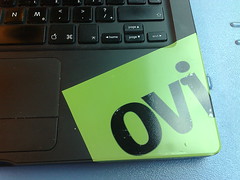
Patching up my BlackBook with an Ovi sticker
Originally uploaded by schickr.
Poor thing has a crack at the seam near the O

Big post-its
Originally uploaded by schickr.
The minute these came out people started drawing.

That ain’t no workshop post-it
Originally uploaded by schickr.
The lines don’t invite doodleing, but long text tracts. I’ve been ignoring them, natch.

Waiting for it to start
Originally uploaded by schickr.
I was listening to Ira Flatow interview a guy from the Mars Reconnaissance Orbiter team. The guy said they were getting a tera-byte of info a week, more than they can handle.
Why don’t they just put that all in the public domain, let some hackers create a great interface, and let people ‘roam’ the data sets and start making their own discoveries.
Astronomy already gets a huge boost from ‘amatuers’. Why can’t NASA?
Link: Mars Reconnaissance Orbiter: Home:
NASA Orbiter Provides Insights About Mars Water and Climate
NASA’s Mars Reconnaissance Orbiter is examining several features on Mars that address the role of water at different times in Martian history
Just heard about a new feature in Twitter that lets you ignore the noise and get alerted to the signal, albeit a signal you choose.
In my ramble on noise, this is the kind of thing I was thinking about, but this is the current digital version of it, whereby you still need to specify the filter, so nothing new there.
Alas, the signal comes in the usual form – a Twitter message. I wonder how that could come a different way.
Also, if everyone understood that their Twitter streams were being watched, how long before folks modified how they ‘tagged’ their twits to be caught by these filters (ugh, maybe even causing signal spam)?
It’d be interesting to get some stats on this after a while.
Link: [hat tip, alexdc] Twitter Blog: Tracking Twitter:
You can create as many of these as you want, so send “track drinking tea”, “track iphone”, “track walking san francisco” and you’ll receive matches for all. Want to get a list of what you’re currently tracking? Send “track” alone (or “stats”). Turn them all off by sending “track off”.