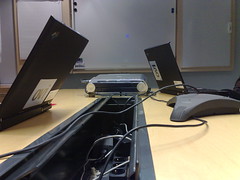
Ovi sticker sightings
Originally uploaded by schickr.
At an Ovi meeting, of course. But, I’ve been seeing them all over the company. đŸ™‚

Ovi sticker sightings
Originally uploaded by schickr.
At an Ovi meeting, of course. But, I’ve been seeing them all over the company. đŸ™‚
For all the Grinches out there who prefer the precise silence and ‘control’ of the way we currently use our internet app, here are a few points in favor of noise:
Hmm. What would those senses be?
Read the other articles in this series:
1. Rambling on noise: The signal in the rambling.
2. Ramblings on noise: If the internet were noisy, what would our senses be?
3. Ramblings on noise: Filtering the fire-hose with ease.
4. Ramblings on noise: Interquantum translation.
I’ve spoken about how quiet the internet really is, how it’s not noisy like a cocktail party. This is mostly because the current model of transmitting and receiving quanta is point-to-point: the receiver selects the streams of quanta they give attention to. In the first world (analogue) we actually have a mass of jelly in our heads that rides the noise and is extremely adept at pulling out the signal as necessary.
I want to add one more aspect to this, one that I think the second world (digital) is better at: format conversion.
I’ve been mentioning ‘streams of quanta’. The term ‘quantum’ comes from physics, where it means a packet of energy, usually in relation to elementary particles and their behavior. In my case, I am using it as a unit of information, the smallest piece in the stream that is enough to communicate something.
In the first world, this could be our name, a tune, a smell, it’s the thing we interpret in the stream. Also, we do format changes based on the sense used to receive that stream of quanta. A good example of that is turning visual quanta into physical quanta, such as printed text into braille.
We can do this much more easily in the second world. For example, AndrĂ© could have been following his friends’ playlists by only the visualization of the music, rather than a text list. And how many people now follow their Twitter streams via their phone vibra or message tone?
Cultural reference: The Matrix. Cypher and Neo watching the raining green screen, the only way to really follow the noise of the Matrix, to see what is what.
My vision of an Interquantum Translator converts streams of quanta into other streams of quanta.
Could this then be a key to being able to follow the noisy internet? Text is slightly hard to scan, but what about sound or visuals – both of which our brain is much better at sorting out?
This reminds me of two stories:
So my questions remain:
I previously mentioned the example of iTunes sending out (narrowcasting? unicasting?) Bettina’s playlist and AndrĂ© having selected it to listen to. That’s attention that is selected, like going into a cocktail party and only sensing (hear, smell, feel, see, taste) what you want to select and not sensing the rest.
Indeed, our whole model of subscription to feeds is an attention selection. We need to make the choices a priori as to what streams of quanta we want out apps to pay attention to.
But as humans wending our way through a rich analogue first world, we are awash with noise. Our brain has not only evolved to sense some important streams of quanta, but kick-ass in picking the signal from the noise.
Test we all passed: In a really crowded and noisy cocktail party, someone calls to you. You hear it and turn to the person.
Sound at a cocktail party is easy to understand,. There are other simple examples as well:
How in the heck can we design our internet apps to be like us: to revel in the noise, yet when the signal hits – BANG! – it zeros in on it and tunes in?
A colleague (let’s call him AndrĂ©) was listening to music i iTunes one day when a playlist popped up from someone else on the network (let’s call her Bettina). He could not remember who she was, but was thrilled with the songs in her playlist.
When he told me the story, it got me thinking about how quiet we’ve built our apps that use the plumbing that is the internet.
In this case, Bettina had set up iTunes to be noisy, to transmit on the iTunes frequency quanta of info, the info being her playlist. AndrĂ© had then set his iTunes to receive on the iTunes frequency. But, here’s the rub: iTunes can only be set to receive Bettina’s playlist, a link he made manually.
In the first world (the analogue world), that’s not how it’s like, is it? In a cocktail party, the noise is not only mixed voices in a channel, but a mixture of quanta of info – voices, clanking glasses, feet, music, lights, sights, smells, vibrations, temperature.
As a receiver, we have a handful of sensors to receive these quanta and process them all at once.
In AndrĂ©’s case, the equivalent iTunes experience in a first world cocktail party is his ability to follow a conversation. But the rest of the party is silent.
Yes, odd. To me, we’ve designed our apps for selective hearing at the expense of the noise.
In a cocktail party, the signal is separated from the noise via attention, but the noise is still there, and still being processed, albeit at a different level.
How can we do that with internet apps? How can we listen to all the playlists out there, from which we can pull out a stream of quanta, in this case a playlist, by just giving it attention?
This is the thought I had:
‘I’m starting to realize that the internet is one global cocktail party – there are apps everywhere spewing out quanta of info in a sort of global noise.’
Wondering if this thought held water set off a brain-wave around noise and the internet upon which I will ramble across a bunch of following posts.

Poor User Interface
Originally uploaded by schickr.
This is the control panel for the hockey rink scoreboard. There are some visual cues to separate the sides of the board. But the most important button – for stopping and starting the clock – is the same as all the others. Usually the time keeper is watching the game. Note the tape someone put to make finding the button easier. Also, watching folks struggle with this tells me there’s significant room for improvement.