Cathal Garvey – indie biotech

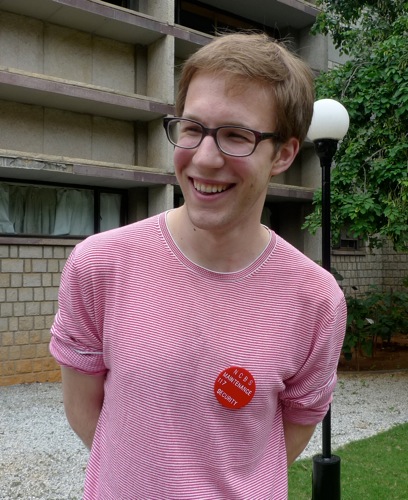
As you might be aware, I proposed a panel for SXSW [http://panelpicker.sxsw.com/ideas/view/10348] on DIYbio. One person who I think epitomizes DIYbio is Cathal Garvey. He’s builds instruments (the Dremelfuge), gives numerous talks (here at Ignite Dublin), gives workshops, compiled a practical guide, and even applied for a license from the Irish EPA. You can’t go wrong learning from his adventures in Indie Biotech.

He is one of the panelists I’ve chosen, and he’s agreed to come (if he can make it). I asked him a few questions about DIYbio and the panel. Here are his replies:

What drives you to do what you do?
“The most amazing work is done by the passionate, and it’s hard to be passionate about science when you have to fit into the straight-jacket of a profit-driven or grant-dependent organisation. Some of the biggest problems out there are both economically unviable to solve and are fundamentally boring, meaning that it’s hard for either traditional category of science to address them. I want to have the power to address the things that matter to me, and to see others do the same.”

Why do you think we should tell the SXSW crowd about the future and impact DIYbio?
“I’d like people to realise that biotech is going to become commonplace someday, just like mechanics, electronics, and computer programming. That this means two things: Firstly, that countries that are burdening biotech with scaremonger-fed legal systems or overly protective “Intellectual Property” are hurting their present and future in this wave of innovation. Secondly, that now’s the time for people to press for openness and accessibility in this technology, by taking part or supporting the work of DIYers who aim to kick-start Open Source biology.”

What would you be doing if you weren’t being a bio tinkerer?
“I’d probably still be pursuing a “traditional” career path in academic science, hoping that in ten or twenty years I’d have my own lab in which to tinker and students to do it for me. I’m too impatient now that I realise there are other, faster ways to choose what I research.”

What’s the one thing someone can do before they come to our panel to prepare?
“Read about biotech, life science and genetics on wikipedia. As with any engineering or science panel, I imagine we’ll bury ourselves in jargon sometimes and have to dig our way back out. If people know what DNA is, how it leads to proteins in cells, and what that means for how biotechnology works, they’ll be ready for the more abstract discussion on the implications and potential of biotechnology.”

Anything else you think might be relevant to help someone decide about the applicability of our panel at SXSW?
“Any tech conference needs to prioritise present and future technology concerns in a good balance. At present, silicon is king and programming for online social webapps is the big trend, but “Big Social” is already feeding into and morphing into the next-big-thing; massively distributed empowerment. Biotechnology, as a tech platform, comes pre-loaded with distribution and personal empowerment; I predict a dovetail between what we’re seeing happen right now and where biotech is going to enter the public awareness. SXSW would be doing itself a big favour by presenting DIYbio and Open Source Biotech this year, while it’s all coming together so quickly.”

What do you think of Cathal? Let us know!


Is Evolution Predictable? – ScienceNOW

“Fifty to 100 genes affect whether a worm enters the dauer state. In theory, deletions on any of them could keep worms from becoming dauer larvae. But many of these genes affect several aspects of the animal’s development and physiology, whereas the pheromone receptors simply sense the environment and thus can be lost harmlessly, Bargmann suggests. The study may point to “a general rule,” adds Phillips: that evolution tends to delete genes whose loss will not have widespread effects, an idea that is very slowly gaining ground.”

Interesting. In my head, it’s really about “adjacent possibles”, so in this case, the pheromone receptor was it. Perhaps changes in one of the other 50-100 genes are not an adjacent possible for the phenotype they found. In any case, quite interesting. And I’m sure folks are going to study how complex these changes can be.

Read this article…

PLoS Pathogens: Selection of Resistant Bacteria at Very Low Antibiotic Concentrations

“These results add another dimension to the evolution of resistance and suggest that the low antibiotic concentrations found in many natural environments are important for enrichment and maintenance of resistance in bacterial populations.”

I get a feeling that antibiotics will soon become as archaic as blood-letting. The sooner we deal with the consequences that any amount of the current selection of antibiotics is just generating super-bugs, the sooner we can get off traditional antibiotics. I’m really hopeful of new ways to controls microorganisms that would be a healthier mix (rather than the usual single target that can be evolved around) of other microorganisms, highly specific chemicals, and targeted designed nucleic acids.

But, then again, what do I know? What do you think of the future of antibiotics?

Read this article…

Ancient DNA reveals secrets of human history : Nature News

“The past months have seen a swathe of discoveries, from details about when Neanderthals and humans interbred, to the important disease-fighting genes that humans now have as a result of those trysts.”

Really nice article on the state of ancient DNA genomics. Really interesting and makes me imagine what the world was like with other Homo species around. And then I wonder why we are the remaining species standing.

Read this article…

Brown calls change to brewery rules a ‘job-killer’ – Boston.com

“Senator Scott Brown yesterday condemned a rule change at the state’s Alcoholic Beverages Control Commission that beer makers say could harm 25 craft brewers in Massachusetts, and even put some smaller companies out of business. The ABCC issued the revised rule, which has yet to be finalized, earlier this week. It would require the roughly two dozen local brewers operating under a so-called farmer-brewery license to grow at least half of the hops or grains they use to make beer, or get them from a domestic source.”

I think the ABCC has their heart in the right place – support local grain growers. But I’m not sure how this will impact brewers, as I don’t think Massachusetts is a big grain paradise, say, like some mid-west state.

One thought might be to create a “Mostly Mass” sort of label identifying brews that use mostly local ingredients. I think that’s more in line with how folks have been promoting local farmers than some blanket un-competitive license change.

What do you think?

Read this article…

Photos: Mass. breweries and their top beers – Boston.com

“Brewing good beer isn’t something unique to Ireland, Germany, or the mountains of Vermont. In fact, there are quite a few craft breweries in Massachusetts that find an appreciative customer base both inside and beyond the borders of the Bay State.

“Here are 10 breweries and brewpubs that produce their suds in the state, as well as the most popular beers they produce.”

Read this article…

Sociometric Solutions deploying digital ‘dog tags’ to track employee interactions – Boston.com

“The digital dog tag, which Watertown-based Sociometric Solutions calls the “sociometric badge,” has a built-in microphone that can gauge how much you talk (versus how much you listen); an accelerometer that can tell how much you sit versus how much you move around; and an infrared sensor that can tell when you’re facing other people wearing the badges.”

Read this article…