-
"For each group of parts, we’ve added text and pictures to better explain why and how you’d want to use those parts in larger systems."
This is a distinct improvement over the previous version. Though I would like to see even more visual guides to exploring the catalog.
-
"The sheer size and diversity of the DNA samples collected allowed the researchers to construct a human family tree based on their analyses. Not unexpectedly, the tree they constructed fits well with current theories on the genetic relationship between Africans and non-Africans; namely that all non-Africans are descended from a particular group or groups of people who were the first humans to migrate out of Africa tens of thousands of years ago."
-
"People actually read, and many of them are willing to pay to support their habit, as the multi-billion dollar publishing industry would attest (and this is just in U.S., and quite frankly, we aren’t the most reading-intensive country in the world)."
-
Pretty nifty. A computational command line on the web with a really nice graphical summary. Information rich without being cluttered.
"Wolfram|Alpha just went live for the very first time, running all clusters. This first run at testing Wolfram|Alpha in the real world is off to an auspicious start, although not surprisingly, we’re still working on some kinks, especially around logging."
When the Central Dogma is not enough – microbial small RNAs
 One thing that has always bugged me was a sort of pendatic repetition of what's called the Central Dogma of molecular biology – that DNA goes to RNA goes to protein.
What bothered me was that it way oversimplified the complexity of information transfer and control in organisms. And for me, the excitement has been in all the exceptions to this Dogma.
For example, I had a sort of Rip van Winkle gap between when I left science to when I re-engaged years later (missed the deep stuff, while keeping up lightly with the superficial stuff). Back in 1999 we were talking about some weird things going on in nematodes, where you could control gene expression simply by adding some small RNAs to cells. Fast forward to 2006 and I find out that these small RNAs have been found everywhere as a control mechanism.
Now mix that with the resurgence of microbiology (or at least it looks like a resurgence to me) and folks are starting to use small RNAs as a way to read gene expression patterns in micro-organisms. The idea is that it's a quick readout before the organism starts responding to the effects of collection and removal from its native environment.
"If we think of marine bacteria and their proteins as tiny factories performing essential biogeochemical activities — such as harvesting sunlight to create oxygen and synthesize sugar from carbon dioxide — then the sRNAs are the internal switches that turn on and off the factories' production line. Their discovery in the ocean samples opens the way to learning even more detailed information in the lab: the researchers can now conduct lab experiments to look at the effects of environmental perturbation on microbial communities. These new sRNAs also expand our general knowledge of the nature and diversity of these recently recognized regulatory switches." [apologies to the person I got the link of, as I have forgotten who it was]
Cool.
Image from wikipedia

Mendeley, the future of science publishing
I was at Next09 this week, giving a talk with Rudy de Waele on "Mobile 2.0". Next09 was a good conference, a mix of talks in German and English, covering things like social media, Web tech, and mobile. And, of course, I caught up with a ton of interesting folks I know, and met a ton of interesting folks I was pleased to meet.
There were some startups also pitching there. I met Jon Froda and Ezra Goldman who were pitching their companies, working in helping corporations capture processes and manage change processes through more social Web services, respectively. I also met Renato Valdes Olmos who had a cool NFC social gizmo.
Bringing citation software to the Living Web
One particular startup I almost missed (Rudy pointed it out to me) was Mendeley. I had heard about it from some of the folks I follow on Twitter (as @molecularist) and had it on my "must check" list, but had no idea what it really was. Rudy summarized it succinctly as "Think of Last.fm for scientific papers".
That was enough to grab my interest, as it seemed to touch on key aspects of the future of scientific publishing that I have been thinking and thinking and thinking and thinking of over the past 18 months or so.
Mendeley is a combination Web and desktop app service for managing your bibliography of science papers. A desktop client helps you extract metadata, annotate, and share the scientific papers you add to your bibliographic database. You can also backup your database online and fill the database ("one-click") with papers from other publication databases.
One of the key upcoming features is a "recommend" feature that helps you find other papers related to the ones you are collecting.
I suppose one could say it has features from delicious (social bookmarking) and StumbleUpon and Last.fm (social discovery), with a twist of sematics and data-mining.
I got a demo of the desktop app and Website and am really impressed. It seemed simple and useful and all the right elements were there.
Kindred spirit
Victor Henning, who is the Founder and Director of Mendeley was kind enough to sit down and talk to me after his talk. He indulged me in my excitement to share thoughts with him regarding what they were doing.
He told me that the idea for Mendeley arose from his and a friend's general frustration in using citation tools that were basically industry standard. Like all great services, Mendeley was something that they built because they needed something like it.
They've been brewing the service for a few years, and have been in a beta for about 4 months. Already they have thousands of users from some of the top research institutions in the world, and are growing at a great clip. Based on the papers placed in the system (over a million), the largest groups of users are from life sciences and computer sciences.
Another cool story is that they reveal a lot of the usage stats, and saw an emergent version of an impact factor as an article from PLoS rose to the top among the most added paper in their database (I think the Web is so well suited to track emergent authority and such).
Good foundation
I shared some thoughts I had about science publishing, and it seemed that some were issues Victor was thinking about. He's quite excited about the service and feels like he could always do more. We touched upon a ton of cool potential and upcoming features. And like always, ideas are more plentiful than one can implement. But, the core is solid, they have a grate foundation that they can build upon, and their position enables them to offer valuable services that folks would pay for.
Furthermore, he mentioned some designers and developers who are working with him and it seems he has an amazingly strong team to make this happen. What's more, some folks from Last.fm, Warner, and Skype have put in 1.5M Euros into Mendeley. So they are going to be moving along for some time still.
And something tells me I'll be cheering for them all along.
links for 2009-05-06
-
This is great. Way to go Bezos.
I am reminded of Clayton Christiansen's observation that disruptions are usually pooh-poohed as expensive, underpowered, and so on. Well, folks, this is a disruption akin to the Netbooks (which Russ Beattie pointed out as well), even if it isn't perfect. Though I think it might fail with the "off-the-shelf" criteria, which Netbooks do not.
I wonder if it'll show two book pages when viewed in landscape. In any case, this is a portable bookstore and library (read this article by SBJohnson [http://online.wsj.com/article/SB123980920727621353.html] for more insight into the Kindle's impact).
As for the article, there is a gratuitous reference to the iPhone. The author really worked it in. Just grates on me when folks do that.
-
-
links for 2009-04-28
-
"Direct synthesis of genes is rapidly becoming the most efficient way to make functional genetic constructs and enables applications such as codon optimization, RNAi resistant genes and protein engineering. Here we introduce a software tool that drastically facilitates the design of synthetic genes."
-
"On February 4, Pattie Maes and Pranav Mistry of MIT’s Fluid Interfaces Group were the talk of TED2009 when Pattie demo’d their Sixth Sense technology. The technology was developed on hardware available today. The total hardware cost was around $350. The system gives the user fast access to a wealth of information."
links for 2009-04-23
-
"Bill Nye "The Science Guy" was booed in Waco, Texas in 2006 for suggesting the Moon did not generate its own light, but reflected light from the sun. "
via @rvidal -
That's interesting.
"I think it's unfortunate that so many of the blogs that have risen to some note in the past few years have been built without that idea at their core, given rise to a host of desperately over-written blogs, all crying our for attention, without a clear, personable voice of their own."
-
the Domino's Pizza fisco
-
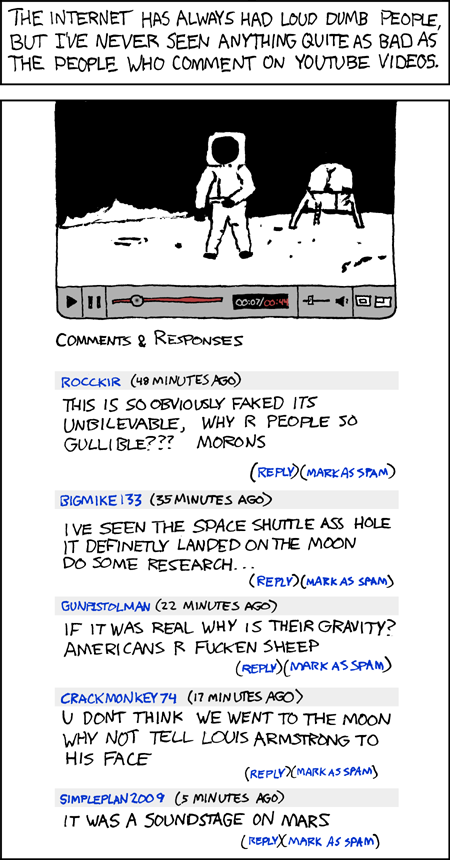
The state of YouTube comments. via Tommi V
links for 2009-04-22
-
via @StoweBoyd
-
"In the countryside of Finland, solitude is a national pastime"
-
Ha!
-
Interesting, but still not convinced if a rock at about 1AU is a requirement.
"The Holy Grail of current exoplanet research is the detection of a rocky, Earth-like planet in the 'habitable zone,'" said Michel Mayor, an astrophysicist at Geneva University in Switzerland."
links for 2009-04-21
-
"Researchers who have trained a tiny virus to do their bidding said on Thursday they made it build a more efficient and powerful lithium battery."
Ah, never thought of having a virus build the structures. Always figured using bacterias to either make proteins for batteries or laying down structures outside their cells. But to use a virus, crevar. [via @Open_bio]
They changed two genes in the virus, called M13, and got it to do two things: build a shell made out of a compound called iron phosphate, and then attach to a carbon nanotube to make a powerful and tiny electrode.
Ginkgoo comes out with BioBrick Kit with New England Biolabs
 Gotta say that it's really good when you can start buying kits that make things easier and push down the threshold for someone to do something (especially in science).
BioBricks are standard parts used to make functional pieces of DNA that can be placed into bacteria. The guys behind BioBricks, and their commercial spin-off, have been building and cataloging parts in a Registry of Standard Biological Parts. Making a catalogue and building standard parts are considered a big chunk of getting Synthetic Biology (synthbio, as others call it) off the ground.
Now Ginkgoo, a player in synthbio and a team of folks who are drenched in BioBrick use and knowledge, have released a kit to streamline the assembly of BioBricks into multi-part constructs. And with folks like Mac Cowell of DIYbio working on the manual, there's hope for us outside of acedemia.
A young company with lots of promise, it's great to see them starting to flesh out their products. Looking forward to meeting these folks some day.
Image from the NEB product page.