-
[via GigaOm] I hope these five areas have helped define and frame how to think about alternative data dimensions on the web.
SwitchAbit as the great data switchboard in the cloud
Just stumbled upon this (no longer remember how):
Link: At SwitchAbit, Twittergram Shares a Common Future – GigaOM
So what is a SwitchAbit? Think of it as a web services switchboard that allows you to plug any type of content from one service (say Flickr) to another (say Twitter) — or even between multiple services. The dashboard is likely to be released later this summer.
Last year I had a few Ramblings on noise that focus on the internet as a noisy environment with data emanating from apps all over the place and how can we find, navigate, recombine, and contribute to that noise in a human way.
I’ve read a few recent posts that revolve around this topic and that I am still trying to digest. But, these thoughts tie three key trends I see unfolding before us: lifestreams (human streams of data), mechstreams (streams of data from machines), and the semantic web (meaning attached to everything).
links for 2008-05-11
-
He visited us in Helsinki a few years back. 🙂 Wonder what his Dopplr journal looks like…
Mowser and dotMobi: Ouch, the cognitive dissonance is huge here for me
What do I get when I mix a top level domain I really do not like, with a concept (transcoding) that I have been grappling with for years, and two really smart guys I highly respect (Russ Beattie and Mike Rowehl)? Severe cognitive dissonance.
I don’t know what to think.
DotMobi
Ok, I am not of the ‘one Internet’ crowd that believes that mobile devices need to be able to view the Web same as any PC. I think that there is and should be many ways to mobilize Websites or use Web services on mobiles. But, I am not of the camp that thinks we should have a top-level-domain specifically for mobile sites.* To me, that’s a ghetto, a return to the bad parts of WAP. So, dotMobi has never sit well with me (this is NOT my employer’s view, mind you).
Transcoding
There is a place for transcoding, depsite what some very very good friends, who know better than I, advise me. Yet, Mowser, which was recently acquired by dotMobi (see link below), is a transcoder. I like it. Some folks (even dotMobi, it seems) are not into transcoders (such as Google’s proxy) that munge all the hard work the Web developer has done. Mowser does a good job trying to stick to that work, and also provides options to go to the full page.
Miker and RussB
Gosh, these are two very smart guys who truly understand the fusion of mobile and Web. And they have the tech chops to put their ideas in practice (magdat and Mowser are examples). Russ and Miker took the ultimate gamble to get Mowser off the ground. Unfortunately, they need to recharge their batteries now before putting in another crack at their ideas, with the learnings from Mowser strengthening them. I am looking forward to them coming back in a few months or a year, reinvigorated and ready to shake the tree some more.
So, yeah, it stinks that Mowser didn’t catch. But, is it good that a top-level-domain company is getting into transcoders? Eh, could be, at least for dotMobi. They already offer a tool from mobileSiteGalore to help folks make .mobi websites (I use Winksite for my personal site and Nokia Conversations, I also use Mippin for Nokia Conversations). Mowser can be well integrated into that.
What do you think?
So, yeah, 1) good for Mowser, 2) good for Miker and RussB, 3) good for dotMobi. It’s just the dotMobi part that must be grating on me. Eh, my problem, not theirs.
Congrats Miker and RussB!
Link [via Tweeps @twhume and @mtrends]: dotMobi Acquires Mowser Assets
dotMobi’s acquisition of Mowser’s technology, developed by Bay Area mobile pioneers Russell Beattie and Michael Rowehl, is another way for dotMobi to provide a complete range of mobile content creation solutions for businesses of all sizes.
…
“At its heart, Mowser is a PC website-to-mobile website content adaptation engine,” said Trey Harvin, CEO of dotMobi. “dotMobi has been vocal against ‘blind’ content adaptation because it doesn’t allow site owners to have control over their content. dotMobi believes that brands and businesses should always have the final say over how their material is presented, and that the content should uniquely take advantage of the capabilities of a mobile device. This has been one of our core philosophies all along, and something dotMobi is looking forward to addressing with the integration of the Mowser assets into the dotMobi product line.”
*I do think .sex would make a great top-level domain. It can be typed with just the left hand, and might cause a flurry of left handed domain names to be registered. Heh.
links for 2008-05-08
-
Heh, my kids have been slaving in the kitchen for some time. Mr13 is pretty creative, too. And, it’s great to sit back and ask them to make dinner. Better yet is when they offer.
-
My favourite squid…
links for 2008-05-04
-
“Vt. town battles to save roadside mural from state ban”
-
For more than four months, perplexed scientists have struggled to understand why upwards of a half-million bats may be at risk of dying in the dark caves and mines of Massachusetts, Vermont, Connecticut, and New York.
Betafence: Must be temporary
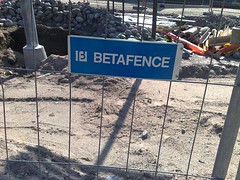
Betafence: Must be temporary
Originally uploaded by schickr.
16:00 26 April, 2008 26042008395