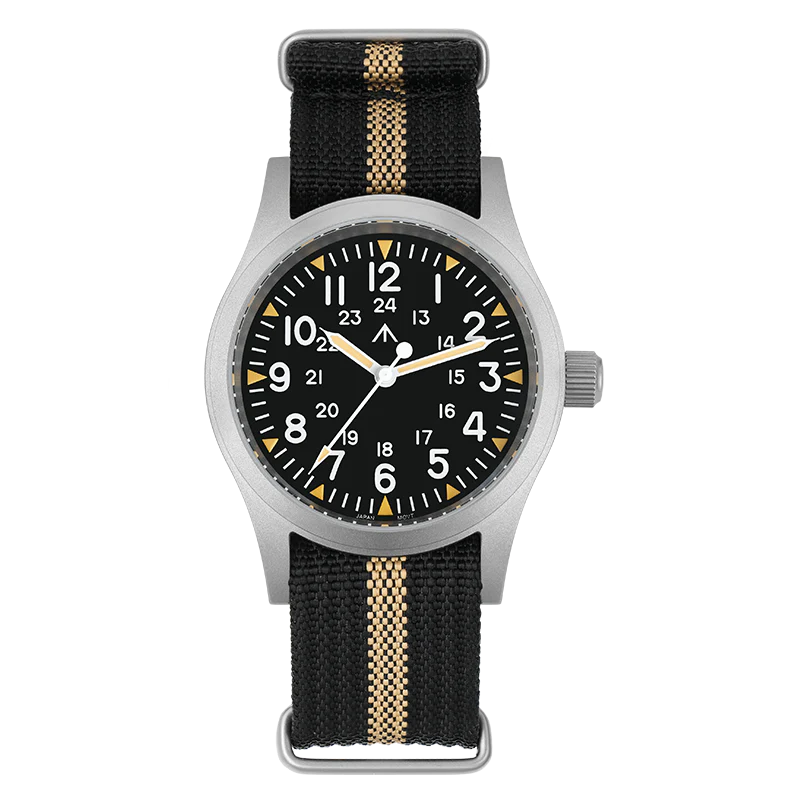
I went on a journey to get an analog field watch. I did get one I am happy with. But I learned a few interesting things along the way.
Fine things are not for me?
I inherited a lovely automatic Tissot Seastar 7 with Visodate from my parents. My mother had bought it for my father in the 70s. About 20 years ago or so, they gave it to me.
The watch is lovely – slim, simple, clean. I was told not to expect it to be waterproof, so was careful that way. And it had a leather strap, anyways, so not fit for swimming or showering.
I wore it all the time. And that was the problem.
Insight: I shouldn’t have nice things.
The first big damage was the crown got ripped off somehow. I was likely handling something bulky that pushed up against the watch. After that I let it sit for a long time as I knew the price of repair was high. So I sadly went without it for a long time.
When I finally got the courage to get the almost $1k repair done, I was happy. And started wearing it again.
But then I broke it again. Seems the rotor has been knocked loose.
Again, I shouldn’t have nice things.
I realized that maybe I should get a watch that is more robust and geared for my daily use.
Bang-around watch
I am by no means a watch fanatic, but I do like reading up on watches, seeing different types. And one type that caught my eye was the A-11 field watch.
The A-11 field watches were made in the thousands during WWII for the Army Air Force. They were simple, had hacking second hand (pauses so that everyone can synchronize to the second), had glow in the dark indicators, were waterproof, and were hand-wound or automatic. Yes, I love automatic watches.
There were a few A-11 recreation models I had my eye on, but turns out most of them over $500, which is beyond what I wanted to pay for a bang-around watch.
Looking on eBay for used ones from WWII, they also were a tad expensive, but ALL of them were severely beat up.
That was when I had my next insight: These were mass produced watches, made in a time when watches were worn ‘until they died or the owner did.’ They were not considered heirlooms or collectables.* They were just daily modest watches that were worn without ceremony and would get beat up, no big deal. Only in the past decades did their value and nostalgia go up.
Roll my own?
For some time I’ve also been considering just getting a watchmaking kit and going thru the assembly process. With a kit, you get case, hands, face, movement, strap and then slowly assemble it over the course of a few hours. I even started reading up on movements, parts, tools and then pricing things in case I wanted to assemble a kit myself.
Nonetheless, this still cost a few hundred dollars for an automatic movement with a set of parts to assemble. And hard to find the small size that A-11 were (watches were smaller back then).
Insight: This whole area of roll-your-own is interesting and there are a lot of videos to learn from, and sites and parts to choose from. Maybe for now I won’t do this, but it’ll always be in the back of my mind. 🙂 And I encourage anyone interested in watches (and with the money) to consider rolling their own.
Hm, quartz
As I was not finding something automatic I started looking for hand-wound watches. But that’s not a thing one can search for easily, so no luck there.
So I figured, I had to go with quartz battery-powered movements. And that’s when I had my last big insight in this quest.
I guess I was a snob, wanting automatic, and non-Chinese. Mostly, that’s what I had, and all nice watches were automatic. And, of course, the WWII A-11 watches were automatic or hand-winding (no battery powered back then, I think).
I did some digging and comparison of quartz movement field watches (many!) and came upon one from Militado. The watch was the right price point, right size, right look, right features. Except it was quartz and Chinese.
Yet, the Militado came recommended by a bunch of reviewers. The manufacturer seemed really into military watches. And the movement was actually Japanese (ok, so I’m still a snob). And, even tho I am usually a no-brand kinda guy, I liked their wee logo and placement and chose a version that actually had their logo.
They what, now?
I mentioned a final insight I had. The funny thing it came AFTER the decision to get the watch.
Insight: Field watches in the 70s-80s all went quartz. What’s more, the favorite Navy Seal watch is actually DIGITAL – the G-Shock series.
Huh.
So, in this journey, I was a purist, chasing down a watch that even the owners had a utilitarian view of, but now can command hefty prices. In the meantime, while the style persists, the movements have modernized to quartz. And even current military don’t use analog watches, but digital. And we might pooh-pooh Chinese makers, but in my research folks talked about good quality and even some good movements coming out of China. Call me converted!**
Are you watch-curious as I am? Would you ever build your own? What do you wear for daily use?
*My father was in the Army Airforce, drafted soon after D-Day, training as a bomber navigator. I never saw anything of his from that time, much less a watch. Alas, he’s no longer around for me to ask about what he remembers.
**To be open, I did buy a Chinese watch for a project. It was huge, had many complications, and was, as needed by the project, automatic. My wife says I got it out of a gumball machine it is so flashy (that was on purpose). But the complications stink and the watch can’t keep time. So I guess as with anything, mind how the price compares to the product. If it’s really fancy and cheap, like my gumball machine watch, that’s not a good thing. If it’s modest and reasonably priced, like my Militado, then maybe your’e OK.
