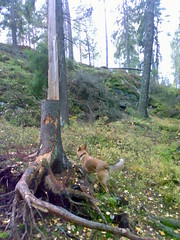
Funky stump
Originally uploaded by schickr.
08:02 Wednesday, 11 October, 2006 Image 143 Jippo and I have been wandering in other woods nearby.
Funky stump
Originally uploaded by schickr.
08:02 Wednesday, 11 October, 2006 Image 143 Jippo and I have been wandering in other woods nearby.
Another word I struggle with at work.
Services – Uh, like experiences, this word is starting to bore me. It’s just that everything we’re building for the Web seems to be a service. Heck, the whole Internet is becoming one big ‘service’, so why do we still need to use the word?
You can review all my previous ‘Tired Words’ here on this page.
File this one as ‘Something said daily at work that I can’t avoid’.
Experiences – Ugh. From commodities, to packaged goods, to services, to experiences. I’m just tired of hearing it. It’s so broad, so undefined. Yes, you build it, but experiences are particular to the user to the product. Alas, I think I’m stuck with this one.
You can review all my previous ‘Tired Words’ here on this page.
I am constantly trying to improve the way I communicate thoughts and concepts I have, trying to have an economy of words, yet very descriptive expressions. Today, I was reading a narrative of the future of the mobile lifestyle and, sparked by a particular sentence, got my head around an issue I’ve been grappling with.
What bothers me is that when we talk about the mobile Web or mobile Internet it suggests a different Web than the fixed, broadband Web. My struggle comes in being able, on the one hand, to say that there is but One Web, there is only One Internet, and, on the other, discuss the Web one lives when mobile.
Well, starting today, I will call the distinction the ‘desktop Web experience’, or ‘desktop Web’, and the ‘mobile Web experience’, or, as before, ‘mobile Web’. It harks back to the foreground-background concepts defining experiencing the Web from the PC (now to referred to as ‘desktop’) and the mobile (which, due to my position, I might be ‘forced’ to call ‘multimedia computer’, or ‘MC’ – heh).
I know these are boring semantics, but I just don’t want to confusion to lie on the word ‘Web’, but on the place of the experience. Nobody (anymore) wants to just convert and shrink the desktop Web experience onto mobile devices. There is indeed a whole different paradigm for the mobile Web experience, an experience that is defined by the Mobile Lifestyle.
No sooner had I put Internet and Online on my list of Tired Words, I came across this article by Luciano Floridi. It was a follow-on article of a similar near-future look at the Internet, written in 1995.
It was an amazing article, getting a lot of thinking going for me in many ways. For starters, he uses the word ‘infosphere’, which, to me, approximates best what I feel when we struggle to explain what the Internet, what being online, has come to mean.
He says, early in the article:
"Infosphere" is a word I coined years ago on the basis of "biosphere," a term referring to that limited region on our planet that supports life. By "infosphere," then, I mean the whole informational environment made up of all informational entities (including informational agents), their properties, interactions, processes, and relations. It is an environment comparable to, but different from, "cyberspace" (which is only one of the sub-regions of the infosphere, as it were), since the infosphere also includes offline and analog spaces of information. We shall see that it is also an environment (and hence a concept) that is rapidly evolving.
And later in the article:
The digital is spilling over into the analog and merging with it. This recent phenomenon is variously known as "ubiquitous computing," "ambient intelligence," "The Internet of Things," or "Web-augmented things." It is, or will soon be, the next stage in the digital revolution.
And also (which appealed to my long-time ubicomp love):
Nowadays, we are used to considering the space of information as something we log in to and log out from. Our view of the world is still modern or Newtonian: it is made of "dead" cars, buildings, furniture, clothes, which are non-interactive, irresponsive, and incapable of communicating, learning, or memorizing. But what we still experience as the world offline is bound to become a fully interactive and responsive environment of wireless, pervasive, distributed, a2a (anything to anything) information processes, that works a4a (anywhere for anytime), in real time. This interactive digital environment will first gently invite us to understand the world as something "a-live" (artificially live), i.e. as comprising agents capable of interacting with us in various ways (shoes, for example, used to be "dead" artifacts, but you can now interact with the pair of Nike shoes you are wearing through your iPod). Such animation of the world will, paradoxically, make our outlook closer to that of pre-technological cultures which interpreted all aspects of nature as inhabited by animating spirits.
Next, it was his comments on the rate of growth in data (next quote) that put me onto the thought that our measurements are too small to be used anymore to talk about huge (for us) sizes, which led me to wonder if we still need such measurements.
Although the production of analog data is still increasing, the infosphere is becoming more digital by the day. A simple example may help to drive the point home: the new Large Hadron Collider that is being built at the CERN to explore the physics of particles will produce up to 1.5 GB of data per second, or an estimated 5 petabytes of data annually, a quantity of data hundreds of times larger than the Library of Congress’s print collection (estimated at 20 terabytes) and about as large as Google’s whole data storage, reported to be approximately 5 petabytes. (If you’re having trouble with these units, a petabyte is 1,024 terabytes, and an exabyte is 1,024 petabytes.)
And, looking at my notes, he started mentioning the flow of data, talking about ‘superconductivity’ and ‘friction’ and ‘frictionless’ flow. Two thoughts came to mind, that in the famous phrase ‘Information wants to be free’ (by my idol, Stewart Brand), ‘free’ meant ‘cost’. But, thinking of information that runs and moves constantly in communication networks, I think ‘free’, to me, means ‘roam freely’ without friction or barriers.
The other thought, that I see in my liner notes was that radio (wireless) connections are mostly short range. With data networks, wires will rule, wires will be the real pipes of the Infosphere. We can never be truly wireless. I am no longer sure what the connection was, but I think I was trying to envision a Hyperconnective World where there were no wires, anywhere.
Because of their "data superconductivity," information and communication technologies are well known for being among the most influential factors that affect friction in the infosphere. We are all acquainted with daily aspects of a frictionless infosphere, such as spamming, and concepts such as micropayments, which become possible only when there is no friction in the transmission of payment information between parties.
Being a scholar, Floridi also started talking about treating the Infosphere as an ecology that also needs attention, stewardship, and study. That made me think of someone being called a Digital Ecologist (for some reason, danah boyd comes to mind). The thought really tugged at my forgotten academic side – ah, the Great Questions.
We should be working on an ecology of the infosphere if we wish to avoid problems such as a tragedy of the digital commons. In other words, we are leaving our children not just a slew of planetary environmental problems, but problems that will infect and contaminate the infosphere as well.
Oy, this is a long post, with all that quoted text, so you should definitely read the article in its entirety (and also the original article from 1995, since it is still interesting).
There were two other things he said that I jumped on that jarred my thoughts once more of a post-electronic age.
He mentioned the ‘mind’ of appliances. It kinda reminded me of how I describe to my children the ‘mind’ of animals. Animals are best at being who they are. A rat is the best goddamn animal at doing what it does. Its mind and body responds to the environment in a rat way and it so happens that some of that response is highly sophisticated and displays rat intelligence. But, don’t ask a rat to be a dog or any other animal. Its mind can’t do that any more than our mind can do what a rat’s does.
on the one hand there is the human user’s outside world, and on the other hand there is the dynamic, watery, soapy, hot, and dark world of the dishwasher; the equally watery, soapy, hot and dark but also spinning world of the washing machine; or the still, aseptic, soap-less, cold, and potentially luminous world of the refrigerator. These robots can be successful because they have their environments "wrapped" and tailored around their capacities, not vice versa. Imagine someone trying to build a droid like C-3PO capable of washing their dishes in the sink exactly in the same way as a human would. It makes no sense. [emphasis, mine – CS]
The other item, that has its own particularly problems in a post-electronic age: power.
Sufficient battery life: One important problem that we shall face will concern the availability of sufficient energy to stay connected to the infosphere non-stop, not just through our working day, but through the rest of our waking hours (and possibly even while we sleep). It is what Intel calls "the battery life challenge."
My thought? It’s alive! Just keep feeding it pellets. 🙂
My struggle here is the definition of this word. Too vague.
Online – Everything that communicates or uses data is connected to the net or will be (to be simplistic). Why, then, is ‘online’ a separate concept? It’s a utility, a place of living and business, the fabric that connects the modern world, what we ‘do’. If a company has an online group, does it have an offline group? Online should be part of all groups. Online isn’t a separate biz function, but an underlying connector.
You can review all my previous ‘Tired Words’ here on this page.
embrace the Internet, excel with software applications and services
Yep. That’s my job.
The upsurge of the careless use of this word has me spinning.
Community – Same as innovation. It’s something you see after, rather than can craft before. A bunch of people do not make a community. Example: Myspace is not a community any more than New York City is. Myspace is a huge collection of very small and intimate communties, much like New York is about communities based on neighbourhoods, shool groups, co-workers, extended families, etc. Communities form on their own and cannot be created like Athena out of our brain. Maybe it’s the attempt to create communities by fiat that annoys me.
You can review all my previous ‘Tired Words’ here on this page.
Scott made a comment earlier about Artificial Intelligence, stating basically that the optimistic Singularitarians are mixing up simple (‘Weak’) AI versus (seemingly) complex (‘Strong’) AI, and the potential of Strong AI in software actually happening to propel them to their Rapture of Singularity.*
Scott linked to some thinking he has (see quote below) that I agree will be where we truly get Strong AI like activity – from the Web itself.
Scott mentions aggregation of ‘online gestures’ and ‘collaborative intelligence’. Others have also called it the ‘lazy Web’ – asking a question to a community of real people (not some search robot) that then returns the relevant answer.
Current aggregation of online gestures seems to be still more explicit, requiring a explicit connection to those gestures or some sort of explicit reading of the outcome, say joining the right community or following it via RSS.
I think what Scott is getting at is how to easily link that collective intelligence in a much simpler way, in a way that it happens without any explicit work having to be done, and, of course, he, too, sees mobile tools in the equation.
Yes, I think part of the next wave of the Internet (not to hype, but I feel it’s already started, the current wave already being quotidian) will have this collective intelligence more integrated into our lifestyle than it is today.
Link: Scott Rafer at WINKsite � Blog Archive � My Entire AC2005 Presentation in 7 Words.
I’m committed to working with two startups right now, and there’s a tagging-related company that I might start. All three are working to sum up online gestures in new ways to serve us all better. For Wireless Ink, it’s the gestures of mobile web users. Dave and I think that we can make the mobile web transparent to broadband Internet users in ways it never has been and needs to be. At Delight, it’s the gestures of women, assembled in savvier ways than I’ve seen elsewhere. The Collaborative Intelligence of mobile web users and women will teach us all a lot.
*Scott sorry for being so slow to respond. I wanted to think a bit more about what you said.
