Do you set goals for the heck of it?

Last November, I participated in NaNoWriMo, a month long writing frenzy with the sole goal of writing 50,000 words (“quantity, not quality”). Not only was it fun to have such an arbitrary goal, but I was able to get down storylines that had been banging in my head for a long time, got to flex my narrative writing muscles (it’d been a while), and I was able to accomplish something concrete (which became more concrete when I stopped editing the book and printed it via LuLu.com).

No, this month I’m not going to participate in NaNoWriMo, despite being in the midst of my own writing frenzy on a new and more complex book. Though, the idea of spending 30 straight days of barfing out a story no longer seems far-fetched, now that I have done it once.

Which leads me to the idea of the effect of setting goals for the heck of it.

Twenty-one days to habit
Back in September I participated in a discussion around health monitoring devices and behaviour change. We wondered a bit why many of these devices, such as the FitBit, only held interest for about three weeks. We thought it had something to do with the idea that repeating a behaviour for 21 days is enough to form a habit. Might it be that after three weeks, folks no longer needed to measure themselves, that they had internalized (made habitual) the understanding that the device revealed?

Indeed, I too found that after three weeks, the FitBit was less relevant to my daily life – my behaviour was modified, I was more aware of my own activity levels.

That got me thinking what I could accomplish in three weeks that might lead to a new behaviour. And, with NaNoWriMo in mind, what kind of accomplishment might I be proud of after those three weeks.

Around the same time, I saw in someone’s Twitter bio that he had run consecutively for hundreds of days (though it might have been thousands).

Therefore, I decided that I would run consecutive days, 5km or more, for three weeks straight. Since I made the decision at the end of September, I figured to make it neat, I made it “consecutive running from 01Oct to 21Oct,” not counting my runs of 29 and 30Sep.

Obstacles, of course
The catch was, for most of October, I was traveling to Germany and California with many day trips, as well, meaning that I had to squeeze in my runs as best I could. For example, I ran jet-lagged on my first night in Germany, after arriving on the red-eye in the morning and hopping off to another town for a day trip. I ran late late at night (11pm PST) on a treadmill (only time I didn’t run outside) full of rich food and booze after a day with friends in California (oh, and this was two days after returning from Germany – so double jet-lagged there). A few days later, I went out for a run hours after returning from California on a red-eye (oh, it was painful, though not as much as the treadmill).

Towards the end of the month, I had a day-trip to NYC and other day-long activities that had me running laps up and down my 200m-long driveway and a bit around the property for variety (the dogs found it amusing) – it was starting to get dark early and one can’t run at night on the roads around my house.

I even headed out on the windy and wet morning as hurricane Sandy approached. And the night after Sandy, it was a torrential downpour that I was about to head out into but was lucky that the rain stopped just as I was heading out. And the 2nd day full moon lit the way behind a thin veil of clouds as I did 200m sprints up and down my driveway.

Exceeding goals to inspire the next goal
When I hit day 21, I realized that I could keep doing this, so I modified my goal to go all 31 days of October. And I did. Though I must say, I did not run on the 1st or 2nd of Nov (I will, indeed, go out today, 03Nov on a long run, when I post this).

When I tallied up my distance, I realized by the third week, that if I kept up the pace, I could hit 160km (100mi). While the main goal was 31 days, I made sure I broke 160km (I ended up doing 168km).

So now, the next arbitrary goal is to hit 160km again in November. This reduces the anxiety of having to run consecutive days, but raises the anxiety that I now have to do more longer runs, especially if I skip running days.

Let’s see. I might have to report back if I make it or not.

I think this arbitrary goal got me out running more, setting a big goal that might be a permanent goal. Much like NaNoWriMo showed me I can crank out a book if I just get down and do it, achieving and exceeding my running goal gives me confidence in setting bigger goals.

Don’t you think?

Do you set arbitrary goals to get you to do things, just for the heck of it? And have you succeeded in those goals?


Image via Josiah Mackenzie

Ego play: My Erdős–Bacon number is 7, sort of

Paul Erdős was the most prolific publisher of mathematics papers (more than Euler). Much like Six Degrees of Kevin Bacon, mathematicians have an number to connect mathematicians to Erdős, as measured by paper co-authorship networks. It’s called the Erdős Number.

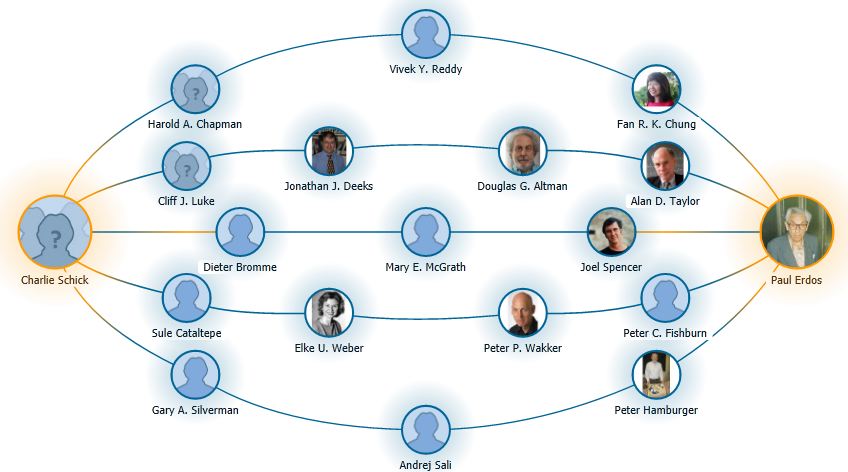
I suppose, to be a purist, these connections should be via mathematical papers, but there’s a tool from Microsoft to connect authors via any published paper. If you’re like me and have published papers, put your name and Paul Erdős in the search boxes to calculate the distance – your Erdős Number. As you can see in the figure, I have an Erdős Number of 4 from multiple paths via co-authors on some of my papers.

That’s cool.

The thing is, there are some actors who have low Erdős Numbers, such as Colin Firth, Natlie Portman, and Mayim Bialik. Yes, geeks who are also famous actors.

Of course, these folks also have Bacon Numbers (which you can look up on Google or use this cool Oracle of Bacon tool). And if they have Bacon and Erdős Numbers, it’s only fit to calculate an Erdős–Bacon Number [Portman, 6; Firth, 7; Bialik, 7]. A fun write up on this is on Wikipedia.

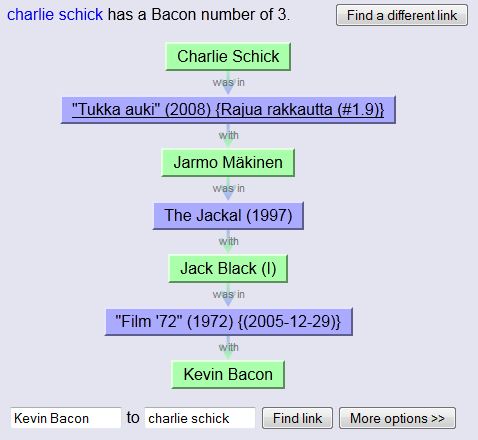
Of course, to be a purist, Bacon connections are via movies. Now, what only few know, I was in a scene in a soap in Finland (here’s the IMdB entry – and, lo, my own IMdB entry). If we were to loosen the Bacon connection rules a tad, to TV shows, The Oracle of Bacon tool, then, is able to connect me to Kevin Bacon (though, the connection is through someone who was not in my scene).

In summary, my Erdős–Bacon number is 7 IF you count my Erdős Number via non-math papers AND count my Bacon Number via a TV show and a cast member I was not in a scene with (though I am sure it’s off by one more link, as my scene was with the lead of the show).

Ah, wait while I let my ego thrill. 🙂

But why the heck was I looking into this?  I’m writing a new novel where there are a ton of smarties with low Erdős numbers. That got me doing all the research and then doing some vanity checks. And, yes, Kevin Bacon will have a cameo appearance to give all the characters a defined Erdős–Bacon Number!

Now back to whatever you were doing before. Or go flatter yourself and let me know your numbers!


Other notes: I mentioned to my brilliant wife that I have a Sagan Number of 4. She then pointed out I knew his ex-wife Lynne Margulis (when I was in grad school) for a 2-degree of separation. Yeah, my life is full of 2-degree to fame and success (and more). Sigh.

Brief commentary on App.net, the new social network “that aspires beyond chat and ads”

I’ve been meaning to comment on App.net, a new for-fee social networking service. To me, it seems that App.net is trying to build an alternative social web – one where the users are not the product and the service isn’t built for advertisers to mine.

Is this a Shadow Web? Is this the first step to taking back the Cloud (here are my rants on this)? Can this blossom into a peer-to-peer social networking system where the apps live on the edge, the data belongs to the user, and where some third-person (aka the advertiser) isn’t mining all you do for their own benefit (and not yours)?

Glenn Fleishman, from TidBITS, has a great long article on App.net, explaining what it is, what it is trying to achieve, and listing some things that could be built upon it (see below). It’s an exciting list.

TidBITS Opinion: New App.net Social Network Aspires Beyond Chat and Ads.

App.net also isn’t restricting itself to being just like Twitter in terms of features. There’s a lot of room to grow, including messages longer than 256 characters and more interesting relationships among those messages. Feedback from paying users and early developers will certainly shape the kind of features App.net offers as well. Here are a few early ideas for systems that could use App.net’s infrastructure:

  • Build a private text-messaging system like iMessage that uses standard Jabber (XMPP) protocols to create a gateway to work with the Messages app and other chat systems.
  • Provide a kind of spam-free verified short email system among one’s social graph through email plug-ins that would show incoming messages and allow messages to be interleaved with regular email.
  • Offer RSS feeds of all the URLs noted by those you follow, those who follow you, public lists, and other groups.
  • Provide ebook annotation, in which notes could be added to books and automatically synced using EPUB and PDF software that relied on App.net for social relationships, message storage, and message notification.
  • For computer-to-computer interaction, offer an alternative to HTTP, proprietary software, or email. Lightweight “listening” modules and libraries could use App.net as the backbone for sending automated messages, keeping them persistent for later review, queuing them in the event of network or server outages on the ends, and notifying humans of problems or status.

What do you think of App.net? Is this one more attempt by folks who want to keep the Internet open and useful for all? How can this fail? How can this succeed?

Ideas are not unique, no matter how far-fetched – a personal story

Last Christmas-time, I was driving to go get my parents (they live a few states away) and was listening to a Science Friday about Mars. The guest was an advocate for human travel to Mars and mentioned how much it would cost to get there. I don’t know if Ira or the guest mentioned it, but I realized that the cost of the trip, spread over a 5 year program, was on the same order as a blockbuster Hollywood movie.

I immediately dictated an outline story for my entry into NaNoWriMo 2012 (I had recently completed NaNoWriMo 2011). The story would be about a Hollywood producer making a multi-year, multi-movie, reality-TV, and ancillary products production that would follow selection, training, and trip of a crew, the construction of the spacecraft, and other exciting thrills of a novel. [Though, like my other two novels and anthology of short stories, it probably won’t be published beyond a personal copy from Lulu.com.]

Over the intervening months, the outline had become heftier and heftier, so I decided to forgo NaNoWriMo and, last Wednesday, I put down the opening scene. [Usually, my stories bounce around my head for a while, different key scenes developing and begging for attention, until the opening scene gels and demands to be written. It all then flows from that opening.]

Today, I wanted to look up again the current estimates of a manned trip to Mars. An, lo!, I found an organization that indeed is thinking of a commercially-funded Mars mission with funding from a reality-TV show (records indicate the announcement was 01 June 2012).

Human settlement of Mars in 2023
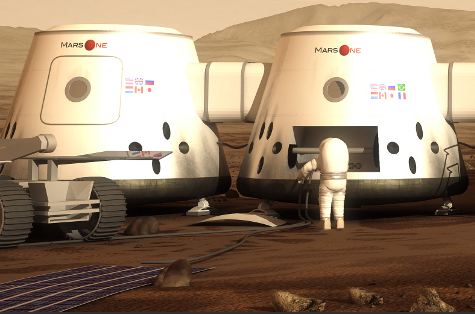
Mars One will take humanity to Mars in 2023, to establish the foundation of a permanent settlement from which we will prosper, learn, and grow. Before the first crew lands, Mars One will have established a habitable, sustainable settlement designed to receive new astronauts every two years. To accomplish this, Mars One has developed a precise, realistic plan based entirely upon existing technologies. It is both economically and logistically feasible, in motion through the aggregation of existing suppliers and experts in space exploration.We invite you to participate in this journey, by sharing our vision with your friends, by supporting our effort, and perhaps, by becoming the next Mars astronaut yourself.

via Home – Mars One.

Ideas are not unique
I’m not saying the brilliance here is on par with Leibnitz and Newton inventing calculus at the same time, but it’s one more of my examples that if you have an idea, it’s highly likely someone else does too. The key thing, of course, is all in the execution. Indeed, I’ve had many great ideas that I’ve seen come into being a few years later. By someone else. By someone more driven and talented.

OK, I never intended to actually drive a Mars program, but, to write the fiction, I’ve done a lot of thinking about it. And, of course, the way I see my story unfolding has the liberty of fiction, for me to craft the storyline in a way that reality doesn’t necessarily allow. 🙂

I wish the MarsOne folks the best of luck. I do think I’ll continue with the storyline, though the thrill of mixing reality-TV funding with a Mars mission has lost its shine a bit. Nonetheless, the story is calling me to write it, and there are lots of twists and turns that I know will not be part of the MarsOne story, so it’ll still be a fun story to tell.

Now is the time
What is true, though, is that I need to get this damned story off my chest, fast, now the MarsOne is making their mark. [And thank you, MarsOne, for some additional ideas for me to consider in my story.]

As for you, if you have an idea you believe in, do it NOW, posthaste, toot sweet. Because there is someone out there with the same goddamn idea, and if you do nothing, they will get all the credit. Even if you planned it all out 6 months or 6 years before them.

Do you have a similar story of a well thought out plan that someone else executes on?

Saturday morning thoughts on the evolutionary history of IBD in Eastern European Jews

Of course, as is usual with me on the weekend, I started reading all my open tabs in my browser. And the first one I read was a paper where they crossed two pure strains of mice and correlated microbiome and genome.

Link: PLoS ONE: Murine Gut Microbiota Is Defined by Host Genetics and Modulates Variation of Metabolic Traits

“In this study, the BXD population [CS: the first generation hybrid mice] was used to detect and quantify genetic factors that may have a significant influence on the variation of gut microbiota. We have demonstrated that host-genetics is complex and involves many loci [CS: locations on the chromosomes]. These differences in microbial composition could impact susceptibility to obesity and other metabolic traits. Functional analysis of gut microbiota and characterization of the relationships with host-genotype [CS: genotype is the sum total of genes] has important implications to human health and agriculture. The gut microbial composition can be temporarily altered through dietary interventions tailored to host genotype, ultimately mitigating the effects of unfavorable alleles [CS: alleles are variations of a single gene across organisms] and inducing profiles that promote human health. Genetic variants that influence gut microbiota may also be used in selection programs of livestock to improve feed efficiency, disease resistance, and to reduce dissemination of pathogens associated with zoonotic diseases such as E.coli O157:H7 or Salmonella.”

Heavy stuff. We all knew this, but needed the simple scientific example of it. And this is foundational for this science moving forward.

Genetic analyses
So what did they do here? Lab mice are usually pure strains where each individual’s genome is identical. When you cross two strains though, the first generation of progeny are all mixed up in their genetic make up. So in this case, the scientists were able to see a whole range of variability in the genome and correlate that to the prevalence of different microbes in the gut. The idea is that regions in the genome would be associated with certain types of bacteria being maintained or lost.

Sure enough, they honed in on a region and “uncovered several candidate genes that have the potential to alter gut immunological profiles and subsequently impact gut microbial composition”. The region was rich in immune system genes. Also, these immune system genes were related to things like obesity as well, suggesting a connection with metabolism of food. Note: it’s not necessarily that there’s some auto-immune issue attacking the animal’s tissue, but could likely be that the immune system isn’t supporting the right bugs.

For those of you who know transfaunation as an option for helping resolve IBD: This might suggest that even if you do repopulate the flora of the gut, the host might not be able to maintain the flora, not just due to diet, but primarily due to immune profile.

Cool, isn’t it?

One comment that struck me, which points to the variability in frequency and intensity of IBD: “variation in gut microbiota and complex relationships with host genetics can represent unaccounted sources of differences for physiological phenotypes including susceptibility to obesity.”

But that makes sense.

What does this have to do with Eastern European Jews?
I happened to have an animated discussion last night with my wife and another couple, who are close friends (yes, we spent a lot of time talking about “poop” at a restaurant; yes, we’re total nerds). As we were leaving the restaurant, my wife reminded me that Eastern European Jews are know to have a higher rate of inflammatory bowel diseases.

That got me thinking.

And this is pure speculation: Eastern Jews are also known to have diseases that are related to genes in brain development. Folks have suggested that the living and working restrictions of Eastern Jews selected for variants of genes tied to things like increased intelligence (for much of their time in Europe, Jews were restricted to certain more white-collar, brain-centric professions). But as a consequence, while having one of these gene variants was helpful to brain development, having two copies led to severe mental development diseases.

So might IBD be a similar thing where the mixed set of genes conferred some sort of microbial or dietary advantage? And then, having the full set of IBD genes causes the full disease? For example, crowded into cities, might have Easter European Jews been more exposed to city and crowding diseases, such as cholera, typhus, or tuberculosis? What is the prevalence of these diseases in Eastern Jews? What is the lung or gut microbial resistance profile in Eastern Jews and Eastern Jews with IBD?

In short, is there a connection between gut issues (or more likely, gut microbe populations) and the evolutionary history of Eastern Jews (city living, profession and dietary restrictions, and so forth). Might the genes involved in IBD, like the the brain development genes, actually present some adaptive benefit at some level?

Kinda makes one think, doesn’t it?


Image from a mouth-watering post on knishes in NYC

Mixing meaning into disease research – Treato

I wasn’t so sure how to describe Treato. It’s really interesting – mixing semantic analysis, social media, medical records, and analysis – Treato is really the next level of how consumers research diseases.

The image to the right is one that came from searching for Lyme disease.

I am not sure how they assemble that graphic, but I guess it’s a mixture of curation (plainly telling the system the usual drugs) and seeing what folks report they took (by combing the web). [Aside: It seems to be just listing the most used drugs (and knowing how the disease is treated, it looks like that to me). I wonder if there’s enough data for them to actually rank the drugs based on favorable outcomes, too. Outcomes analytics is where my head is always at, these days.]

Treato says they identified “over 160,000 English language websites, containing user-generated-content about medications and symptoms.” And that they “have searched and mapped thousands of these sites and indexed over 1 billion posts, covering well over 11,000 drug brands.” And they “have organized and analyzed this vast amount of data to create statistically proven insights about every aspect of medication use” [from their About page.]

I am not sure if they do this, but I’d like to see Treato applying their engine to sites like Patients Like Me, or 23 and Me, where there is an even richer set of data connecting people, disease, and outcomes.

And I am not sure, but they say the throw in patient records from HMOs, which I guess must mean claims data (which one can buy). But it would be cool if they could also mine medical record notes as well. They have the tech to do it, it’s just a matter of pointing their analytics tools to a new source (hm, what about Practice Fusion?).

I’m always thinking of how to extract meaning from medical records. So, Treato blows my mind.

Do you know of any other consumer disease research tools as sophisticated as Treato?

Hm, I wonder if they have enough to model trends, `a la Google Flu Trends, and then predict out-breaks? And it would be cool if Treato published a Health of the Nation – sort of like a Google Zeitgeist – of what is searched for and trends in diseases. I don’t think I’ve seen anything like that. Perhaps the CDC has something like this? For sure Treato is sitting on meaningful data they could use for this report. What do you think?


Big Data, healthcare, devices, and quantified self

When I was at SXSW, I spent most of my time at either Big Data or Healthcare sessions. The interesting thing is that the Big Data sessions always devolved to talking about healthcare and the healthcare sessions always spoke about Big Data.

One aspect of the fusion of big data and healthcare that kept coming up was personal health monitoring. And since SXSW I have spoken and listened to a few folks (@dpatil, @rodrigoATCG, @nagle5000, @syntheticzero, and Sanjiv Shah) exploring measurement, self-analysis, and health devices.

Back in 2004-05, I worked on a product called Lifeblog – it collected all your SMS, MMS, photos, and videos into a timeline on your PC. It was way advanced for its time, and pointed to a future where we would cache our life’s stream of data. Working on that set me off thinking of sensors, lifestreaming, visualization of personal data (one set of discussions around visualizing recorded mobile phone usage data involved a colleague who left Nokia to set up @futureful – yes Nokia dabbled in this space once), my vision for what was supposed to be Ovi, my interest in lifestream aggregation, and a dotted line all the way to me getting involved in Big Data and Healthcare and Life Sciences in my role at IBM.

So, what do I see today in terms of these personal health devices?
At HIMSS in February, a big healthcare IT event, there was a whole section promoted by Qualcomm that was about mobile health measurement devices, such as the Asthmopolis inhaler sensor, and many mobile cardiac monitors. Also, there is a strong move (disclaimer, IBM is a big promoter) of the Patient Centered Medical Home (PCMH), which calls for sensors to provide independence to the patient, care to be provided outside the clinic, and constant monitoring for adverse events.

Nike Fuel was all over SXSW, and FitBit is expanding their their product portfolio. IBM is involved in the (young-mom) activity monitor BodyMedia. And here’s an article of the VC behind the gamified (shudder) heart monitor, Basis. And 23andMe’s Linda Avey (@lindaavey) started up a company (with Mitsu Hideishi, @syntheticzero)  called Curious, specifically to explore how to make personal health data available to the (non Quantified Self) masses.

And of course, I don’t need to go into the amazing things happening in the Quantified Self world. Here’s an exciting post of a recent meet up. Look at all the projects!

More recently (and what triggered this post) is the news (link via @erigentry) that FourSquare founder, Naveen Selvadurai, is getting into health monitoring. Nothing captures the attention more of investors than some successful entrepreneur entering a new field that most mainstream folks have not thought of.

Innovation from the outside
One thing that hit me is that whatever arises from the fusion of Big Data and personal health measurement, it will come from outside the healthcare industry. Part of that is because in the healthcare industry, they are thinking of hospitals, chronic conditions, FDA, reimbursements, privacy, and so forth. Too much baggage, I think.

I had hoped that payers would see the importance of tracking health outside the clinic, especially for incentives or rebates on paying for care. My thought now is that they will end up buying someone rather than building something.

Which leads me to my realization that folks outside the industry have none of that baggage, have oodles of experience in consumer web services and data visualization, and, perhaps most importantly, view these devices as curious toys that are begging to be played with in interesting and novel ways.

But the challenge is not to alienate the non-techies who are interested in keeping an eye on their health, but are not as driven as the usual QSer. QSers are the bleeding edge of all this. My brainwave here and excitement is how to being this to the rest of us, making the ideas of QS more mainstream.

“It is NOT about the data but how it inspires”
This quote is from Rodrigo Martinez (@rodrigoATCG) from the IDEO healthcare practice. It dovetails nicely with a comment from DJ Patil (@dpatil) that, “OK, so my super intelligent scale tells me I’m fat. But I can see that looking in the mirror.”

“Inspire” is what I’d expect from an IDEO designer, and that’s fine. But for me, it’s really about motivation – how to stay interested in my health, effect the changes that need to be done, and be proud of my accomplishments. I don’t think “gamification” (as in badges and levels) is the answer (and I find it a bit tacky). I think there are more positive ways to motivate people – competition, social pressure, monetary incentives (and of course, I’d love to see the health plans get involved – even perhaps mandating).

What behaviors are we trying to promote by making this data visible to people? And, more importantly for anything that tries to optimize a parameter, what should we measure? Obviously the parameters we measure should represent something we wish to modify (isn’t the whole point about modifying a behavior to maintain or improve health?).

What do you think?
Next Monday, I’ll be in Minneapolis participating in a predictive analytics event. I’ll be part of an executive roundtable, a breakout session on predictive analytics, and a general audience talk on the Predictive Power of Big Data Analytics in Healthcare. One thing I will touch on is the fusion of Big Data and personal health monitoring (another reason for this post). I’m sure I’ll get a lot of feedback on this topic – the event host is a device manufacturer with some monitoring devices of their own.

I also wanted to point out that IBM, my employer, published last year an excellent report on “liberating the information seeker” and The Future of Connected Devices (download PDF). I highly suggest you read it if you’re interested in this space.

So, what do you think? Do you use any of these devices, even just a heart rate monitor while running? A pedometer? What do you think will be the way we bridge the intense measuring world of the quantified self to a user of a device who just needs a little help to stay healthy?

Of course, this post is about devices and personal health. I see some interesting opportunities with personal medical records. But that’s a different aspect of Big Data and healthcare and best left for a different post.

I’ll leave you with a video of a well-used healthcare monitoring example at IBM – the Data Baby. Read the case study too (PDF). Disclaimer, I am part of the team that sells the streaming analytics product used for this project.

Data Baby

Image from dpstyles™ (There’s a weird cognection behind this image: I searched for CC images of Nike Fuel on Flickr and came up with this one, which I thought was pretty cool. When I looked at the other images, I realized this was Dennis Crowley’s stream. This post was triggered by a the Selvadurai news item mentioned above. Weird.)

Finally got around to reading Sterling’s “An Essay on the New Aesthetic”

“That is my thesis; that’s why I think this matters. When I left the room at the SXSW “New Aesthetic” panel, this is what concerned me most. I left with the conviction that something profound had been touched. Touched, although not yet grasped.

I’d suggest getting right after it.”

I missed the session at SXSW (can’t get to all of them, you know). But I’ve been reading bits here and there of how it influenced folks’ thinking [Here’s one by @thisischristina that mixes New Aesthetic with gene network refactoring, synthetic biology, Synthetic Aesthetics. “Pixelating the Genome“]

In the article quoted above, Bruce Stirling, gives an overview of the field, ties it to other areas of aesthetics and technology and philosophy, and then nudges New Aesthetics on its way with paternal pat on the tusch, a request, and a “get to it.”

via An Essay on the New Aesthetic | Beyond The Beyond | Wired.com.

We interrupt our usual program …… Down With Everything

Thomas Friedman recently wrote about a discussion he had with Frank Fukyama on the two-volume opus Fukyama is working on “The Origins of Political Order.”

Of course, I hardly ever get political here, but this article resonated with me.

“Indeed, America today increasingly looks like the society that the political scientist Mancur Olson wrote about in his 1982 classic “The Rise and Decline of Nations.” He warned that when a country amasses too many highly focused special-interest lobbies — which have an inherent advantage over the broad majority, which is fixated on the well-being of the country as a whole — they can, like a multilimbed octopus, choke the life out of a political system, unless the majority truly mobilizes against them.”

I think it’s amazing how well our nation has stood the test of time, seeing it was basically invented by a bunch of rich white men over 200 years ago. But two things always pop back up in my head – perhaps the concept of nation is out-moded and democracy doesn’t seem to have the ability to reinvent itself as radically as it was created.

In one of my novels, I have a character, who is in politics and policy, examine the whole idea and genesis of “nation”. She then discusses democracy and says:

“And the irony is that these are democracies, meaning that they are supposed to listen to the public and follow the will of the public. Yet in reality, the system is so complex that it can’t bootstrap a new system, molt into something different.

“Have you ever seen a democracy revamp itself? No, it can’t generate the necessary discontinuity of the same order that was needed to bring itself into existence.”

Part of me thinks we’re screwed if we can’t get ourselves out of this mess and that this is the worst the US government has been ever. But then the other part of me tries to think back to previous governments, congresses, and presidents and wonder if the immediacy of the stupidity and inanity of Washington DC has always been the same. Only nostalgia makes us forget.

Sigh.

Friedman’s article starts asking if we America needs an Arab Spring. And Fukuyama has some strong suggestions for change. Friedman concludes:

“I know what you’re thinking: “That will never happen.” And do you know what I’m thinking? “Then we will never be a great country again, no matter who is elected.” We can’t be great as long as we remain a vetocracy rather than a democracy. Our deformed political system — with a Congress that’s become a forum for legalized bribery — is now truly holding us back.”

I guess I’ve always been the inactive cynic. And, perhaps, I represent a large majority of the bourgeoisie of America. What’s it going to take to get me moving, if already I know the problem and just sit on my ass, like most of us.

Gah. Perhaps I should stick to science.

And now back to our regularly scheduled program…

via Down With Everything – NYTimes.com.

Note: The article got hundreds comments and I saw good ones. Sigh. If only we had better tools to follow the comments as well. Of course, I’ve ranted about this before (here in 2009 and here in 2008).

Repeated evolution in sticklebacks, and adjacent possibles

“Researchers have documented repeated evolution in other organisms, but the sticklebacks are unique because the freshwater transition has occurred so many times. “Sticklebacks have been a phenomenal system for understanding rapid evolution,” says evolutionary biologist Erica Bree Rosenblum of the University of California, Berkeley, who wasn’t involved in the study. “This paper shows that repeated evolution can occur by ‘reusing’ the same genetic mechanisms over and over again.””

This quote is from a review in Science of a Nature paper where stickleback fish genomes were sequenced and compared. The catch is, the stickleback fish used to be a sea fish until glaciers melted 10,000 years ago and left many stranded in freshwater lakes and streams.

What then happened is that the freshwater sticklebacks all had to evolve to survive in the freshwater.

Independently.

What is interesting, is that it’s clear that all of these fish evolved the same adaptations. And now there is genetic evidence that most of these independent changes were in the same places of the genome in each of these freshwater fish.

While this has been seen in other organisms, the stickleback provide an experiment where this has happened multiple times, showing “repeated evolution can occur by ‘reusing’ the same genetic mechanisms over and over again.”

Adjacent possibles
I am not surprised.

I picked up a term from futurist Paul Saffo, “adjacent possible” (I use it a lot to point out interesting things in evolution). Applied to evolution, it means an organism can really only sample the possible mutation paths that are adjacent to its current make-up. An organism cannot evolve from bacteria to bird in one move, much like “you can’t get there from here” in one move. In both cases, each step must be an adjacent possible step.

In this case, all the sticklebacks had similar adjacent possible ways to adjust to freshwater living. So they were constrained by their genome. But also, the environment exerted similar pressures, so the adjacent possible were further constrained.

The sticklebacks all had to make the same choices, with the same starting material, to adapt to the same environment.

What do you think?

I think this is cool.

Read the review How Evolution Copies Itself – ScienceNOW.