Looking for cheap entry-way carpets at Bauhaus
Originally uploaded by schickr.
12:11 Saturday, 27 May, 2006 Image016
Looking for cheap entry-way carpets at Bauhaus
Originally uploaded by schickr.
12:11 Saturday, 27 May, 2006 Image016
Now why isn’t Nokia making these?* Technically, how hard can it be? And, I am so biased that I think Nokia could kick tusch in terms of usability and such. Heck, just add Skype to my N93 and the battle is over. 🙂
For that matter, why isn’t any of the traditional phone manufacturers making these? Operator clashes?
What do you think?
Link [thanks, Peter B]: Linksys.com – Company/News@Linksys/Linksys Ships Its First Wireless-G IP Phones.
WiFi phones from Linksys enable high-quality VoIP service through a Wireless-G network and high-speed Internet connection. While both phones provide clear and reliable voice communication over broadband networks, users can select the appropriate phone and Voice over IP Service Provider for their specific needs.
*The Nokia 770 doesn’t count. That’s not really a phone.
Google’s CEO, Eric Schmidt, wrote an article recently for the Financial Times (subscription required, but the link below might still be working).
He starts promulgating the democratizing effect of free access to information (over the Internet). He then goes on to, rightly, point out how much more growth there is and how the mobile should be the main access to the Internet in developing nations (see quote below).
Yeah!
Overall, the article is a subtle push at carriers (data and voice) to keep the ‘Net open. Free access to info leads to openness and learning for all, the closing of the knowledge gap, freedom from top-down mass-think, and new ways of growing.
A nice, if light, article.
Go, Open Internet.
Link[thanks, Cristina B]: FT.com / Comment & analysis / Comment – Let more of the world access the internet.
It is for this reason, I believe, that internet access via mobile telephony will have such an important part to play in helping close the knowledge divide between rich and poor.
Mobile phones are cheaper than PCs, there are three times more of them, growing at twice the speed, and they increasingly have internet access. What is more, the World Bank estimates that more than two-thirds of the world’s population lives within range of a mobile phone network. Mobile is going to be the next big internet phenomenon. It holds the key to greater access for everyone – with all the benefits that entails.
To me Google Notebook could have an immense impact across the mobile world (the link to the the post that set me off is below) – if Google realizes all the little pieces they have.
How?
Well, it’s part of some converging trends I (and others) see, and which I think are crucial for the efficient fusion of the Web and mobile.
Trend 1 is getting well established – Transcoders [some hat tips to Russ B and Christian L].
I would love all websites to automagically sense my phone and serve me pages that are layed out and massaged (via CSS) to fit and act properly on my phone. Eh, so maybe the larger sites and some specialty sites will do that. But, what about the bazillion other sites?
Transcoders.
Google has a transcoder. You can either use it directly by typing in the URL to be transcoded, or you get transcoded pages when using Google Mobile.
Trend 2 is growing in the PC world, but not really making an impact in the mobile world – Aggregators [some hat tips to Rich Mc].
I mentioned before that a new wave of aggregators are gaining steam in the PC world. The key thing aggregators (or personal home pages) do is that they allow you to clump together all the info streams you follow into a single UI.
Google Personal Mobile is a mobile version for Google Personal. Yet, it bewilders me that the mobile version is not as versatile as the main version. More on this later. In any case, I am hoping that this new crop of aggregators remember the size of the mobile world.
Trend 3 is still small, small like 1995 – Template-driven mobile site creators.
I’ve spoken about WINKsite enough here. WINKsite has a menu-drive method that makes it really easy for you to whip up a mobile site that actually is useful.
On the other end of the scale, Google Pages totally missed this and seems to me as a Geocities (1995) clone. Where’s the mobile?
Part way back on that scale, I think TypePad is a great and versatile system for creating websites, albeit blog-like ones. Nonetheless, with a few well made templates (which they are good at making), most of their blogs could be made mobile-savvy.
Now, here’s where I think all this can be tied in:
The transcoder is a great way to access info on the Web without having to worry so much about what will show up. It partially understands which pages are already formatted for mobiles. Also, it displays the transcoded page wrapped within a menu system that enables some simple actions (for example, ‘back to results’ or ‘hide images’).
What’s needed is to expand that notion of wrapping pages in a menu system.
Envision this:
I go to the mobile Google Search page. I search for ‘cats’ and then get a list of pages found. When I click on a link (which is in Google proxy gobbledygook), the Google transcoder is so kind to show me a proper mobile page, transcoded or not. Then, and this you cannot do in anyone’s system, if I want to throw it into Google Notepad, there’s a link in the menu below letting me do that.
Now take it further:
I have my own personal page. It has all my feeds, all my info streams. I can read this page from the mobile too. If I see something I want to follow, I can, without worrying about how it will show up on my phone (it’s that clever transcoder). Then, I might want to blog about something I’m reading – there’s a menu item below to let me do that. Or, if I want to send it to my online bookmark sharing service, there’s a link for that too.
Basically, by aggregating the pieces into a unified navigation experience through a central personal portal, sending any information through a clever transcoder, and wrapping it inside a menu system, we can start to return the functionality we leave at our desks.
If you notice, you have a browser, you’ve added buttons and right-click features to it to help you (using me as an example) make a TypePad QuickPost, tag and send the URL to del.icio.us, capture the RSS feed for Bloglines, or upload something to your site or Flickr.
In my limited mind, the only way I see for me to get that full connectivity to all my services and info flow is through a central portal that holds all the pieces, understanding what I want to do with all those nuggets of info. Google has many of those pieces and all they need to do is tie it together (it’s those converging trends).
Of course, for me, I would like to have a system that wouldn’t force me to use Google stuff, I already have my own stuff. Therefore, I think someone outside Google or Yahoo might have a better chance at creating something like this, without having brand conflicts.
It’s not hard (technically) to tie all those pieces together (usability is another story). I know a few people who could do it, too. Privately, I’ve been trying to convince folks that this is the way to go – a way to provide a rich mobile Internet experience. Here, I release the thought into the wild.
What do you think? Did I miss something? Are you working on something similar? I wanna know.
Link: TechCrunch � Blog Archive � Google Notebook Launches: Ho-Hum.
You no longer need to see the pre-release screenshots: Google Notebook is now live at google.com/notebook.
As I mentioned in my previous post, Google Notebook is a direct Del.icio.us competitor. You can bookmark content (a web page or a piece of content on a web page) either via normal Google search (click on the “note this” link at the bottom of a search result), or on the open web with an IE or Firefox extension (highlight text, right click).
Regarding the title: OK, so I didn’t cleverly twist that Churchill quote. 😛
I once heard a story from David Sifry Clay Shirky (ugh, I always mix these guys up for some reason) about how they came up against the technical weaknesses of GPS when trying to create a life-size, city-wide Pac Man game. They had it all figured out and were ready to test it when they learned that GPS stinks in the canyons of Manhattan.
Ever since then, I have had my doubts about GPS in real world (real person) situations. Oh, yeah, there are a few great apps out there. But, I think things change when you shrink the receiver to the size of a pack of gum and shrink the screen similarly.
That’s what I want to understand.
So, through some interesting twists of serendipity, I’m deep into testing GPS apps – with a mobile, of course (currently my N93).
On a tip from my neighbor, I picked up a Holux GPSlim236 and downloaded a (temporarily) free nav app from Nav4All (I got the Holux from them, cheap). I’ve also started playing with some of our own lab apps. No, I can’t tell you about them, but it’s no secret that they connect a GPS device with a mobile display. D’oh.
Soon I’ll also be testing the Nokia Wireless GPS Module (imaginative name, huh?), too.
Ugh, I am descending into gadgetitis. Eh, really it’s for a specific application. Really.
And you? What looney things have you done or heard of with GPS and mobiles? What are your wishes and realities you have around GPS?
After thinking about it for so long (and adding to my good karma by helping it along), the mobile version of Plazer is now in beta.
Plazer is a little app for the phone (and an original version for the PC) that helps you tag a location in the Plazes service. From the PC, the location is captured via the network information (wireless or wired). From the mobile, the location is captured via the cellID.
I think Plazes is nifty on the PC. But to me, it is really promising on the mobile (please, I’ve only had it less than an hour). As you can imagine, the real fun happens when you can build upon the location info: find folks, find access points, find out about the area, tag photos, initiate communication, and so on.
Let’s see how it evolves. I might have to contact them to see how Plazes has been doing.
Link: blog.plazes.com � Blog Archive � Mobile Plazer Closed Beta.
We started a closed beta for our mobile Plazer now. It runs on S60 mobile phones. If you own a Nokia S60 phone with OS version 2.1, 2.6 or 2.8 (N90, N70, 6680, 6681/6682, 6670, 3230, 6620, 6630, 6260, 7610) and want to take part, please drop us a line: support at plazes dot com. The number of users on this beta is limited, so hurry up!
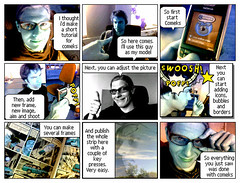
I bumped into Arto at the Global Mobile Monday Summit. He showed me his comics app, Comeks, pretty nifty and quite fun.
Being the online sharing type, I suggested that it would be fun to be able to post comics online.
Well, he’s implemented a sharing feature via ShoZu.
Here’s a tutorial by Arto on how to use Comeks, created in Comeks, and posted to flickr.
Something tells me I might just get into doing something like this too. 🙂
David has an excellent rumination (with good comments) on what happens when we shift to digital media, where all the other stuff normally associated with media delivery, such as advertisements, links to other media, and so on, are gone (quote and link below). David realizes that as we get down to the consumption of pure media, we might be losing the channels for finding other media.
This is an issue that is even more pressing in the mobile domain. Since the beginning, finding content has been very difficult, mostly because there is little room on the mobile for extra pointers to new content. Indeed, much of the effort by operators has been one of marketing marketing marketing, to get folks to know that a) something exists, b) how it can be accessed, c) that it can be done on a phone.
As much as it leaves a sour taste in my mouth, I must say that Jamba’s ‘success’ has been tightly tied to its intense carpet-bombing of popular media outlets*. And, others who have been in the industry have said to me that the quality of the marketing – that is, getting folks to know the abcs of the mobile media – is the make-or-break of a popular mobile media service.
My take is that the next wave of the Web will be in the form of aggregators and services, which will increase the energy of finding something new or unexpected. We have some separate standing services, like Pandora or digg, but the real kick will happen when, as David says, the discovery is in line with the consumption.
That’s where I think aggregators will come in. Aggregators will be able to have their finger on multiple pulses and be able to make things rise to the top, to the attention of the user, in line with normal use.
Right now, word-of-mouth works because it is in line with consumption – you read a blog, hear a podcast, or watch a video and there is a recommendation embedded there (isn’t that the seed of the blogosphere?). Yet, to some extent, word-of-mouth is slow and inefficient, since it requires one to have a connection to that ‘mouth’. At some point, there needs to be some serendipitous event that connects to something new at a higher frequency than just knowing a ‘mouth’.
Read up on the full article. There is some good discussion in the commentary, too.
Link: Genuine VC: Discovery vs. Consumption.
One thing that I’ve been noticing recently is the distinction between the venue for the discovery of media content and the consumption of it. It’s notable to explore, as media distribution dramatically changes, not only is the consumption of content shifting, but also the discovery is as well. And those shifts are not always parallel.
How do you think the uncoupling of discovery and consumption makes it hard for us to do media on mobiles? How can we take advantage of the mobile lifestyle to improve on media discovery in a way that boring fixed PCs can’t match?
Thank you, Om, for bringing this up. But, you know this is not a new ad model. It just seems that way when all we are services hopelessly based on Yahoo and Google ads.
I’ve been telling people until I’m blue in the face that there are more ways to milk ad money from marketing budgets than to just rely on AdSense. Heck, examples of successful models similar to Doppelganger are all arond us.
Sheesh, folks. Read this article and get a clue. 😛
Link: GigaOM : Doppelganger, A New Online Ad Model?.
But there are other forms of advertising besides search, and for its virtual world, The Lounge, Doppelganger has settled on a product-placement model popularized by Hollywood, where advertisers pay up to have their products featured in movies and TV shows. Music label Interscope Records has already signed up for a trial to have Doppelganger build a virtual club for its Pussycat Dolls band within The Lounge.
I will soon be getting a nifty tiny GPS receiver to hook up via Bluetooth to my phone. I’m going to be doing some deep testing and reviewing of an app (and if I get permission, will post it here) that … well, you’ll have to wait for that.
In the process of reading about GPS devices, I remembered Geocaching*. I then did the usual, googling around, and found Geocaching, the site, which seems to be the grandmama of all geocaching groups.
The cool thing is that they have a live link (a KML file) that you can put into Google Earth that will show you the approximate locations and link to the detailed Geocaching cache page. That means that you can rapidly and graphically find caches in an area (there are a few within a kilometer or two of my home – you bet I’m going to look for them).
Sure beats search forms and lists, right? Heck, it’s a damn good link between the physical world and virtual information. That’s a great fusion between a mobile device and Web and PC tools. Now if we could do something about a viewer for the phone, the fusion would be complete.
Read the article below for a light take on the subject of Google Earth being used to help people explore the real Earth.
Link: Future Boy: Google moves into virtual worlds – May. 12, 2006.
You can already download user-generated layers that sit on top of Google’s 3-D Earth and show you, for example, the location of celebrity houses or hiking trails or famous landmarks. One dating service has even started showing people looking for partners as a Google Earth layer.
Real estate companies have started showing off virtual versions of their buildings (for sale in the real world) on Google Earth. SketchUp allows them to build entire models of their apartments, right down to the microwave oven.
*[from Wikipedia] Geocaching, is an outdoor treasure-hunting game in which participants (called "geocachers") use a Global Positioning System
receiver or other navigational techniques to hide and seek containers
(called "geocaches" or "caches") anywhere in the world. A typical cache
(pronounced /kæʃ/ like the English word cash)
is a small waterproof container containing a logbook and "treasure"
(usually toys or trinkets of little monetary value). Some variations of
the game include a point system to enhance game play.