PLoS Biology: A Holistic Approach to Marine Eco-Systems Biology

“In summary, the Tara Oceans project leverages powerful new technologies and analytical tools to develop the first planetary-scale data collection effort that links biogeography with ecology, genetics, and morphology. Guided by the cross-disciplinary philosophy the pay-offs can be immense, considering the massive number of samples and data that have been collected, archived, and interconnected for scientific study, only half-way through the expedition. A lesson from this project is that, when it comes to addressing broad and complex issues of general interest to mankind, competition between scientists may not be the best model. The Tara Oceans project is a pioneering enterprise towards a truly worldwide, systems-level characterization of the largest and most fundamental ecosystem on our planet.”

Cool. In my current job, we spend a lot of time talking to people who are combining huge and disparate sources of data and correlating, analyzing, and exploring the connections. Now, I see this happening everywhere. While the 80s-00s could be the Information Age, I’d like to call the new age we are entering the Age of Data (or something like that – it’s all about Data Analysis, innit?)

Read this article…

Thoughts on completing NaNoWriMo

NaNoWriMo, as you probably know, stands for National November Writing Month. It’s a crazy-ass month-long 50,000-word writing challenge. I’ve known about it for a long time and each year I make a less-wimpy attempt to gear up for it. But for some reason, this year clicked, and I did it.

My experience
I was slow to start (see graph below) and really didn’t get into the whole social aspect of this, you know, sharing the stress with others. I think I was not so invested in actually achieving this, hedging my bets in case I didn’t write much. Of course, the whole social aspect is what keeps some folks motivated. And, thank you, I did like the pep letters sent all month by the NaNoWriMo and the local NaNoWriMo folks (scarily, holding meet-ups just around the corner). But I didn’t get involved more than that.

I had a few notes prepared in advance, a few one liners for plot milestones, a rough idea where I was taking it. Y’see, I have a notebook where I put one liners to help me kick-off a short story (my preferred format, for many reasons). I was excited for NaNoWriMo to get me in gear to write all of these short stories. It’d be an Anthology (my second, by the way).

Then in the dying days of October, I found out NaNoWriMo was specifically for a novel. Gulp. I had to rethink what I was doing. Could I use these short story ideas, weaving them into the overall narrative? Yes, I could. And, yes, I did, it worked well, if I may, humbly, say so.
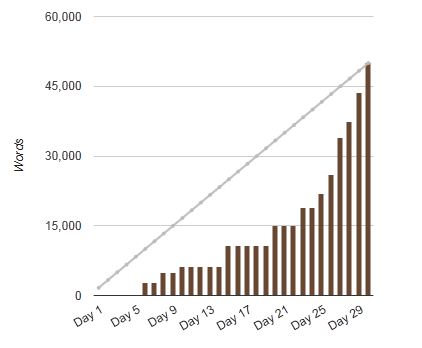
Like I said, I was very slow to start. I was writing when I could, 30 minutes at night, 15 minutes in the morning, the time between when I dropped off my son at the rink and when the game started. I slowly inched my way up. When it was finally Thanksgiving, I knew I needed to give it a weekend push. When I hit 30k, I knew this could be done, I was getting a feel for how much time I needed to get stuff out. When I crossed 40k, I felt quite relaxed, had the last 10k words measured out, I was actually targeting to end the novel around 50k.

Last night, I came home with 3,000 words left. So I had a calm (as usual, long) dinner with the family and then sat down to finish. I kept using the Official NaNoWriMo Word Counter, as it was slightly different (higher!) than MS Word (yes, I wrote on my PC because the Mac is shared and I wouldn’t have it with me when traveling). I was confident I could finish by midnight, so in the last stretch I was not stressed or rushed. It was quite easy, anti-climactic, almost.

The funny thing, I finished the story with a few hundreds of words to go. So it was back to see where I could insert some words without forcing it and messing things up. When I checked again, I has 30 words to go, then 10, then – Well, I wasn’t thinking what would happen when I passed 50k. Suddenly, another webpage opened with a Winner’s Certificate (now on our fridge), and a cute congratulatory video.

I’d done it.

The kids were already asleep. I interrupted my wife as she was watching the 3rd period of Bruins at the Leafs, and did a wee victory dance. She rolled her eyes and smiled, glad to have me back in her life, and told me to sit and watch the the rest of the game (also having an awesome November, the Bruins won!).

So. Have you done this before or this year? Will you be doing it next year?

As for me, I’m starting a new notebook page to start collecting thoughts and plots for next year and we’ll see if I can do it again.

Background
The guy who started it all, Chris Baty (I always think “Batty”), has done this for 13 years (see his completion announcement, NaNo reflections from Chris; and origin story, here). Over the years, the program had grown, adding a Script-Writing Frenzy and a Youth Program (which each year I mention to my my daughter). Chris is now moving on to run the parent non-profit, handing off NaNoWriMo to his faithful crew.

The driving force for this zaniness is to just get folks writing. My favorite line from all this is “It’s all about quantity, not quality”, to get folks off their butts, a sort of no-judgement-zone, a “learn to ignore the editor”, lower you expectations, and just put words to paper – you can sort out the first draft in December.

In 2010, they had over 200,000 participants, with more than 30,000 writing more than 50K words by the midnight deadline. This year they’ve tallied up 3 Billion words (about 60,000 NaNoWriMo equivalents). I don’t know how many finished, as I am writing this before the West Coast wakes to tally up the final count of winner. But Congratulations to everyone who crossed the finish line with me.


UPDATE 08dec11: The NaNoWriMo folks posted all the stats for this year on their site.

Life on Mars Driven Underground? – ScienceNOW

“The new findings probably deliver the final blow to the possibility that the surface of early Mars was a “warm and wet” incubator for any martian life. They are consistent with a history in which Mars has been almost always rather cold and dry, Ehlmann says. The later weathering of rock into salts seems to have occurred during geologically brief intervals when water flowed on the surface, she says. “The most stable, [habitable] environments may have been underground.””

I always fantasized that all life on Mars – microbial – was deep in the rock. And in my story, we’ve given up hope that there’s life on Mars and are colonizing and using water from deep aquifers. But one drilling engineer is surreptitiously trying to find life in the deep water. And does.

Read this article…

Retail biology – Trade Secrets Blog | Nature Publishing Group

“Just as fortunes were made by the designers and manufacturers of the humble mouse mat after the launch of the Apple Macintosh, we are likely to see consumer products exponentially increasing. It is difficult for us now to fully appreciate the number of tiny ICT devices that populate our cars, kitchen goods and even children’s toys; but the time is ripe for a new generation of biotech entrepreneurs to look for novel ways to create consumer products using biological advancements.”

Nice thoughtful article on the future of making things with biology.

Read this article…

Teach me: Does Hadoop signal the end of the database?

I am still a novice when it comes to the technical underpinnings of databases and Hadoop. So, I thought it might be useful if I just asked if my thought on the future of databases is correct.

Basically, “Does Hadoop signal the end of the database as we know it?’

Here’s where this question comes from:
I work for Netezza, who make blazingly fast data warehouse appliances. At the heart of the appliance is a Postgres database. But due to the appliance architecture (and I think the fast speed) you don’t have to do the usual things you have to do to make databases work, such as tuning, indexing, and so forth (indeed, we have a long list of “no”s that set database folks crazy, as in “How can you not do that?”).

That got me thinking. Our appliance has changed the need for coddling databases. Indeed, weren’t databases created to make it easier for (what back then were) slow computers to handle large amounts of data, and all the coddling is to compensate for weak hardware? Would we need databases if it didn’t matter how the data was structured, as long as we had a fast search and processing of the data?

Segue to Hadoop
Lately, at work we’ve been taking about Hadoop, hearing folks actually NOT wanting to have a structured database. And, we see folks with large amounts of data with Hadoop, just throwing more processing power at the data when needed.

Following that thread, I started wondering if the evolution of tools like Hadoop might make structure databases obsolete*, that it really doesn’t matter how the data is structured, just so long as we can find it. And the processing issues are obviated by just throwing more processing nodes at it.**

So, teach me:
Where am I wrong in this thought thread? Will data always need to be structured somehow for computing purposes? How much of the structured data world can Hadoop gobble up (though the unstructured data world must be larger than the structured data world, right?)?

What do you think?


*Of course, just like folks are still using VAX, databases will really never disappear. When a technology is displaced, it usually doesn’t disappear, just gets relegated to a different niche.

**Do you still keep things in folders? I only do when I don’t have a good search tool. On my Mac, I use Spotlight to find and open anything, rather than searching through folders. Indeed, everything usually goes into one folder. Unless I need to separate something for follow up on the desktop (so, OK, folder doe not go away altogether). Nonetheless, search has replaced most of what I would use folders for.

Vampire-like Predatory Bacteria Could Become A Living Antibiotic : Discover Magazine

“What’s the news: If bacteria had blood, the predatory microbe Micavibrio aeruginosavorus would essentially be a vampire: it subsists by hunting down other bugs, attaching to them, and sucking their life out. For the first time, researchers have sequenced the genome of this strange microorganism, which was first identified decades ago in sewage water. The sequence will help better understand the unique bacterium, which has potential to be used as a “living antibiotic” due to its ability to attack drug-resistant biofilms and its apparent fondness for dining on pathogens.”

Absolutely awesome. And if there’s one bug that does this, there must be many many more.

Read this article…

PLoS Genetics: Identification of Widespread Ultra-Edited Human RNAs

“The traditional view of mRNA as a pure intermediate between DNA and protein has changed in the last decades since the discovery of numerous RNA processing pathways. A frequent RNA modification is A-to-I editing, or the conversion of adenosine (A) to inosine (I).”

Hah. One more inflection point in the complexity of molecular biology. I think the reality is that life doesn’t give a hoot about the individual organism, but is one gigantic randomization engine (or should I say, purposeful variation), sampling adjacent possibles, giving rise to genomic variants of all sorts, with some variants tending towards even greater complexity and randomization techniques. [Hm, that’s a brain wave developing there…]

Read this article…

Philips – Design Probes – Microbial Home

“The Microbial Home Probe consists of a domestic ecosystem that challenges conventional design solutions to energy, cleaning, food preservation, lighting, human waste and healthy lifestyle.”

Very cool. And mentions of a Post Electronic Age, too.

Read this article…

Images from Philips – more at Microbial Home


Philips unveils an elegant ‘Microbial Home’ concept | SmartPlanet

“Although these appliances won’t be manufactured any time soon, lifelike models of the concepts are currently on view at the Piet Hein Eek gallery during Dutch Design Week (which opened on October 22 and runs through October 30) in Eindhoven, the Netherlands. While the thought of cooking dinner with gas harvested from bathroom waste might not seem appetizing, the elegant concepts of Philips’ Microbial Home appliance system may seduce some skeptics via the power of their eye-catching design.”

[via @erigentry]

Read this article…

The Guts of Dietary Habits

“There is a multimillion-dollar industry based on the concept that introducing beneficial bacteria into the human intestines will improve our health. The trillions of symbionts in the large intestine profoundly affect our metabolism and immunity. Accordingly, abnormal bacterial communities have been identified in several human diseases such as inflammatory bowel diseases (1–3), colon cancer (4, 5), irritable bowel syndrome (6), and nonalcoholic fatty liver disease (7). The composition of microbial communities is generally stable within each individual. Past studies of the gut microbiota emphasized the huge impact of nutrition (8), which is likely to outweigh that of the host genotype (9).”

Nice review, with some references too. But it really rounds up and summarizes the latest. Also points to an article in the same issue that reports on some really interesting findings. Alas, not Open Access.

Read this article…