Host response: Probiotic ingestion alters mood : Nature Reviews Microbiology

“There is growing evidence that the intestinal microbiota interacts with the host central nervous system (CNS) to modify stress responses and anxiety behaviour; this is the so-called gut–brain axis. Bravo et al.Lactobacillus rhamnosus JB-1 can alter the transcript level for receptors of the neurotransmitter GABA (γ-aminobutyric acid) in the CNS in a region-dependent manner.”

Yet one more data point on the bugs-gut story.

[This is not an open access article. Boo. Hiss.]

Read this article…

PLoS ONE: Barcoded Pyrosequencing Reveals That Consumption of Galactooligosaccharides Results in a Highly Specific Bifidogenic Response in Humans

“Prebiotics are selectively fermented ingredients that allow specific changes in the gastrointestinal microbiota that confer health benefits to the host. However, the effects of prebiotics on the human gut microbiota are incomplete as most studies have relied on methods that fail to cover the breadth of the bacterial community. The goal of this research was to use high throughput multiplex community sequencing of 16S rDNA tags to gain a community wide perspective of the impact of prebiotic galactooligosaccharide (GOS) on the fecal microbiota of healthy human subjects.”

I’ve seen a ton of papers on “probiotics”, but I think this is the first I’ve heard of “prebiotics”. There is mounting data about the effect of gut bugs on our own systems, and there is a growing set of data on how our diet affects our gut bugs. A wee Google search shows that there’s been a lot of papers data on specific foods that selectively promote the growth of specific gut bugs.

Hm, this is really interesting. It all seems to be coming together. My suggestion: if you’re a grad student or a post-doc in biology, human gut microbiology and ecology is gonna be a big topic in the near future. It’s gonna change the face of medicine.

Read this article…

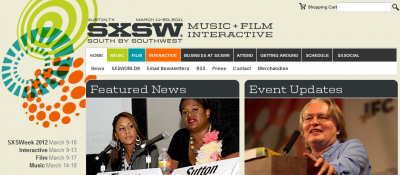
A “shucks” followed by a “yay” and the some: SXSW 2012 panels announced

No, my panel on DIYbio was not chosen.

That’s the “shucks”.

The great news is that Christina Agapakis’ panel “Designing Living Things” did get selected! She’s got a great crowd on her panel: Patrick Boyle, Daisy Ginsberg, Jason Kelly, and Sri Kosuri. A veritable who’s-who in synthetic bio and synthetic aesthetics. It’s a great follow-on to Venter’s talk in 2011. It’s going to be a very interesting panel indeed, and I won’t miss it for anything. And neither should you.

Indeed, Design was one of the ideas I thought would have legs, but I just didn’t have the chops, cred, or connections to have pulled it off, so I am glad that Christina took the leap of faith and set off to organize this panel.

That’s the “yay”.

As for some other interesting science panels:
– Ariel Waldman is running a panel “Get Excited and Make Things with Science” about Science Hack Day. I think this is a better segue from traditional SXSW fodder to science hacking (DIYbio might still be a large leap?).
– Christopher Mims and Michael Coren are running a duo-talk about “OpenScience: Hacking the Scientific Method

Check out the other sessions in this post on SXSW.com.


An eye for success: Jobs tribute from thankful scientists

“The use of computers in science now may bring images of data-crunching parallel processing and Unix-inspired open-source collaborations, but there was a time when the cutting edge — at least for molecular scientists — was being able to draw a benzene ring digitally on screen. Jobs and Apple gave scientists the power to do that, and more besides. Scientists responded with decades of loyalty and, on news of Jobs’s death, with tributes of their own.”

In some fields, such as design and publishing, Macs reign supreme. Science, especially biology, is another area where Macs have been prevalent.

I used my first Mac in college in 1984. It was the original, quickly replaced with a Fat Mac soon after (Boston College was a key Apple school). Soon after graduating, I bought my first Mac, a Mac II. I would use that Mac for almost 10 years to write my PhD thesis, organize my wedding, create some animations (2D and 3D), and write a book and countless short stories.

In the lab
In grad school (’89-’94), we had a zippy Mac SE and another small 9″ Mac (I don’t recall which) in our lab. My boss wrote software to render and animate DNA, for non-linear regression, and run the instruments in the lab (HPLC, pumps, and specs). We also used the computers to design and plan experiments, draw molecules, and keep our lab reagents catalogs (on HyperCard, of course).

In my post-doc lab (’94-99), we had fast, colour machines for writing papers, making slides, keep our reagents catalogs, email (big thing then), surf the new and burgeoning Web (on Mosaic and Netscape 1) for genomic info, ordering, DNA alignments, running instruments, and non-linear regression. The interesting thing is by my post-doc, there were software packages that could do all the things my grad-school advisor has programmed. Quite a change for someone like me who doesn’t program.

No more lab
I left the lab and eventually found my way to a PC-centric corporation – Nokia. I had a few Macs at home, but craved to use it once more at work. After about 5 years, I did get one, and, of course, it transformed how I worked. [Indeed, I used to point out that Nokia kept getting blind-sided by Apple because Nokia’s PCs acted as blinders as to what personal electronics could be like.]

When I left Nokia, I entered a media producer role with two zippy cutting-edge, totally loaded Macs with great software and screen real-estate.

But now, in my current job, I am back to PC-ville, though not so hobbled as in the old days – Windows 7 isn’t so bad (though nothing really works as polished as it does on a Mac – loads of examples), and I still use Firefox and Seesmic as I did on the Mac.

Of course, we still have a few Macs at home and I hope to return to using a Mac for business in the near future.

Lab Macs rule
In any case, I’ve used Macs in all sorts of settings and have suffered the PC world. And Mr Jobs has indeed transformed my life, as he did the lives of all the scientists I worked with. This retrospective of mine was triggered by the article quoted above (link below). It’s a nice commentary of how, even though Apple was trying to be the business computer of choice, it ended up being a strong force in science.

What do you think? How Mac-centric is your lab? Could you imagine doing science without Macs?

Read this article…


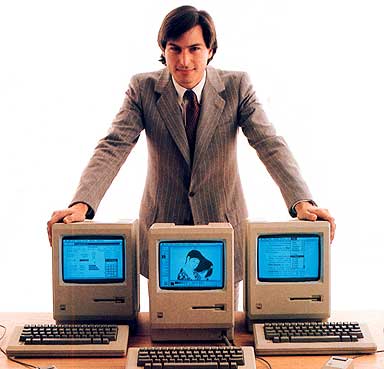
Image from MacRumors

Rediscovering Bits of 1890s

“”Laurie Cox, a graduate student who works in the lab, held up the test tube with the 100-year-old bacterium. She explained that they can determine if the spores are alive by their growth, which should be visible within 24 hours. “I think it’s really interesting and amazing to be able to culture bacteria that’s over 100 years old and to see what we can do with it,” she said. Dr. Blaser said they will attempt to sequence the genome and compare it with a modern organism to see how things have changed. “We’ve had 70 years of antibiotics, so the question is, have there been new changes in the bacterial genome from the time of that organism,” he said on Tuesday. “It’s an opportunity to compare our ancient organisms with our modern ones.””

Really cool. I wonder how many old vials are stored away with interesting bacterial samples.

[via @bruces and @paleofuture]

Read this article…

Outbreak Detectives Embrace the Genome Era: Science

“Genomic epidemiologists say, it’s time to use the technique to track microbial movements on a global scale. By routinely sequencing bacterial samples—perhaps up to a billion a year—scientists could pinpoint the sources of new outbreaks faster, determine whether a bug is resistant to antibiotics, and investigate how public policies or the use of certain drugs change the course of microbial evolution.”

One part of my job is talking to “pharmaco”epidemiologist who take claims data and electronic health records and mine them for outcomes and drug safety and effectiveness. [Plug] Our product can take huge amounts of data and query it at blazingly fast speeds.

For sure, if we have some large pathogen vigilance data stream being added to a large data warehouse (ours), researchers can query and analyze the data and predict outbreaks before they happen.

Read this article…

Experts Debate Polypill: A Single Pill for Global Health: Science

“In the past year, the idea of a “polypill” combining several cheap, well-tested heart drugs has gained momentum, although it still has its critics. … But some question whether a pop-a-pill mentality should be encouraged, and many cardiologists are sharply critical of the potential risks inherent in one-size-fits-all treatment of patients who are not at risk.”

I’m thinking more a personalized poly-pill. Indeed, multi-drug interactions don’t seem to be studied enough. Though I think there’s an opportunity here.

Read this article…

PLoS One: Global Patterns of Bacterial Beta-Diversity in Seafloor and Seawater Ecosystems

“This first synthesis of global bacterial distribution across different ecosystems of the World’s oceans shows remarkable horizontal and vertical large-scale patterns in bacterial communities. This opens interesting perspectives for the definition of biogeographical biomes for bacteria of ocean waters and the seabed.”

This is one cool modern day ecological analysis.

Read this article…

Another step forward in the future of anti-microbials

Title: PLoS ONE: Antifungal Activity of Microbial Secondary Metabolites

“Secondary metabolites are well known for their ability to impede other microorganisms. Reanalysis of a screen of natural products using the Caenorhabditis elegans-Candida albicans infection model identified twelve microbial secondary metabolites capable of conferring an increase in survival to infected nematodes.”

I keep thinking of the Post-antimicrobial Age. Like in this paper, we have spent the last century isolating what Nature has produced (raiding Nature’s pantry?), occasionally tweaking the compounds as they became ineffective.

The thing is, Nature evolves much quicker than we can, and can sample a much broader and complex space of adjacent possible than we can. We’re just not keeping up.

Many are worried that the numbers of new antibiotics per year is going down; that for many nasty pathogens, we’re at a last effective drug or entering the realm of super-resistance. Indeed, it seems that at our current pace, we’re set to lose (though people have been saying that for at least the 15 years I’ve been tracking it).

I see at least two areas that would need to be improved: 1) a more practical use of microbes – better screening of Nature’s solutions, better understanding of the ecology of pathogenesis (these point towards solutions, as is described in the paper above); 2) greater speed in evolving new molecules, exploring adjacent possibles, much like Nature does (rather than slow tweaking of existing molecules).

In short, until we start thinking like microbes, we’re stuck with an ever diminishing arsenal of anti-microbials.

What do you think?