Testing for Disease, for Under a Penny, Using Bits of Paper – NYTimes.com

“The diagnostic tests designed in Dr. Whitesides’s Harvard University chemistry laboratory fit on a postage stamp and cost less than a penny. His secret? Paper.”

I’d read about this before. But glad to see that things are moving along well – funding, products, future. While diagnostics on paper is nothing new (pregnancy and diabetes test, those ubiquitous dip sticks), the creation of channels with wax allows for a more sophisticated chemistry.

This is a great example of lo-tech hi-tech, using simple, long-established tools to do something better. I think folks too often head for the more complex and more expensive because it’s easier and less constrained (I used to say the same thing about dumbphones vs smartphones).

What they’ve done here is printed out wax channels, added some chemicals (by hand!), cut and package the postage stamps. To use it, spot some liquid, the paper wicks the liquid through the channels, chemistry is done, and you read out the color.

Very cool.

Read this article…

Watch the video…

Waste Water + Bacteria = Clean Energy – ScienceNOW

“For the first time, researchers have sustainably produced hydrogen gas, a potential source of clean energy, using only water and bacteria. The challenge now, scientists say, is to scale up the process to provide large amounts of hydrogen for various purposes, such as fueling vehicles or small generators.”

I keep thinking of how to extract electricity or combustible gas from bacteria. And here someone has improved on the process to extract hydrogen in some usable quantity. Seem like there are still a few technical hurdles, but the most interesting comment to me was that they really can’t use ALL the hydrogen the bacteria produce – the bugs need the hydrogen as well. That got me thinking of milking cows – you still need to feed that calf.

Read this article…

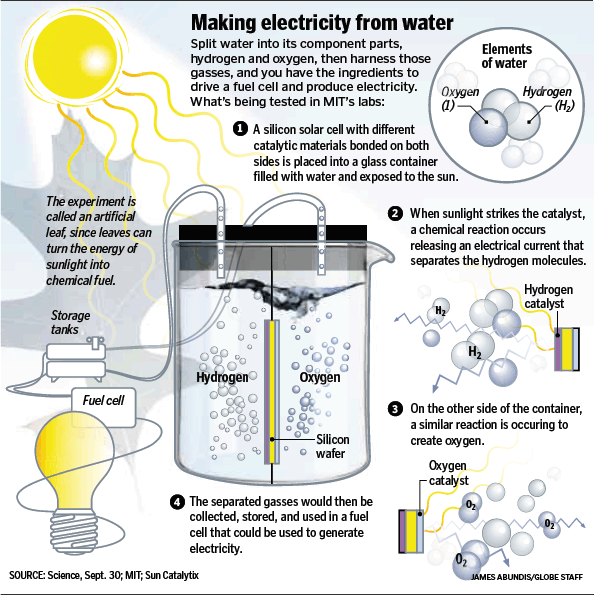
Device uses leaf technology to turn sunlight into power – The Boston Globe

“The thumb-size black strip looks like a thin magnet. But in reality, it is an artificial leaf, made of silicon and capable of using sunlight to split water into hydrogen and oxygen that can be fed into fuel cells to make power. “You drop it in a glass of water and you walk outside and hold it in the sun, and you’ll start to see bubbles of hydrogen and oxygen,’’ explained Daniel Nocera, an MIT professor who led the team that invented the device.”

Quite cool.

Image from the Globe

Read this article…

Want Fatter Cows? Bring In a Zebra – ScienceNOW

“”Natural selection has favored that mix,” says Johan du Toit, an ecologist at Utah State University in Logan. Natural selection, maybe, but not people. Convinced that other grass-chomping animals will drive their herds to starvation, ranchers in Kenya and elsewhere tend to keep their cattle separate from wildlife. But a new study suggests that thinking may be wrong. Wildlife, particularly zebras, can actually help a ranch thrive.”

Another strike against mono-cultures, in this case, cattle. I think this study is a good example of why folks need to take ecological views of plant and animal farming. For example, my son has been experimenting with the old Native American technique of growing corn (tall straight stalks), beans (that climb up the corn stalk), and squash or cucumbers (which spread low below these other two plants). True, our mechanized farming isn’t set up for mixed farming techniques, but the benefits might drive the financials and the change.

Read this article…

Human Excrement to Blame for Coral Decline – ScienceNOW

“Coral reef ecologists have laid a persistent and troubling puzzle to rest. The elkhorn coral, named for its resemblance to elk antlers and known for providing valuable marine habitat, was once the Caribbean’s most abundant reef builder. But the “redwood of the coral forest” has declined 90% over the past decade, in part due to highly contagious white pox disease, which causes large lesions that bare the coral’s white skeleton and kill its tissue. Now, after nearly a decade of data collection and analysis, researchers have fingered the cause of the affliction: human excrement. The finding represents the first example of human-to-invertebrate disease transmission and suggests a practical approach for halting the disease’s spread.”

Really cool detective work. The more I read about microbes and viruses, I see that we’re all really one mass of interconnected organisms, testing out adjacent possibles and inadvertently passing pathogens across species and kingdoms.

And apropos for the two SciFri videos I just posted.

Read this article…

Science Friday Video: An Outhouse For The Sea

“This toilet floats. It’s an outhouse and sewage-treatment plant in one, processing human waste through a “constructed wetlands.” Adam Katzman, the inventor and builder of the toilet-boat, says it’s meant to be more inspirational than practical. “Poop and Paddle” demonstrates how sewage and rainwater can be converted to cattails and clean water.”

This is so clever – constructed wetlands attached to a toilet and on a boat for a bit of flair.

An Outhouse For The Sea

Science Friday video

Science Friday Video: Growing A Wastewater Treatment Plant

“New York is testing out a new water scrubber at one of its wastewater treatment plants in Queens. Meet the algal turf scrubber–two 350-foot slides covered in green algae. Water flows down the slides, algae grows naturally, and then helps clean water that is sent over it. John McLaughlin, Director of Ecological Services for the New York City Department of Environmental Protection (DEP), and Peter May, restoration ecologist for Biohabitats, explain how the scrubber works, and where the harvested algae goes.”

Great simple story – use algae to clean up the water then take the algae to make biofuel. Well, I’d use the algae for compost, if it were not too contaminated. And I’d use an ecosystem of microbes to clean up the water further (it’s chlorinated before being released – that’s cheating, I think).

But a good start.

Growing A Wastewater Treatment Plant

Science Friday video

Don’t Call It Viral Marketing: The Story Behind Contagion’s Microbial Billboard – ScienceInsider

‘The jury is still out on whether the star-studded viral outbreak movie Contagion will be a Hollywood blockbuster, but don’t blame Patrick Hickey if it isn’t. The Scottish mycologist recently led a team that used living bacteria and fungi to create two sinister-looking billboards meant to lure, or scare, people into seeing the movie. The microbes, seeded on stenciled letters in a pair of giant acrylic dishes, gradually grew to form the movie’s title behind glass windows erected in an empty storefront in Toronto, where Contagion was premiering at a film festival.”

This is cool. One for @alexandradaisy and @jamesking!

Contagion’s microbial billboard

Read this article…

Superbugs Predate Wonder Drugs – ScienceNOW

“It’s a “carefully done study,” adds George Church, a geneticist at the Massachusetts Institute of Technology in Cambridge. “Non-scientists (and even scientists) forget how important it is to confirm ideas that are widely accepted,” he writes in an e-mail. Church’s only gripe is that the samples were 30,000 years old, even though antibiotic resistance genes have likely been around for a billion years. It’s “analogous to a super-elegant proof that humans have been using weapons for at least the past 30 years,” he writes.”

Ok, so for me, this is a given: antibiotic resistance has been around for a long time. I never thought that resistance was in response to modern chemicals. Nonetheless, these researchers did lots of work to isolate microbes from 30,000 years ago (Including spraying florescent E coli on the probe. That’s got to violate something.) And, leave it to the inimitable George Church to praise and poke in the same comment.

Read this article…