Proteome-wide post-translational modification statistics: frequency analysis and curation of the swiss-prot database : Scientific Reports : Nature Publishing Group
“Post-translational modifications (PTMs) broadly contribute to the recent explosion of proteomic data and possess a complexity surpassing that of protein design. PTMs are the chemical modification of a protein after its translation, and have wide effects broadening its range of functionality.”
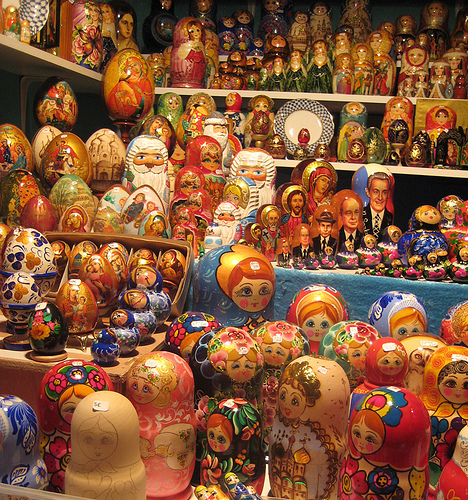
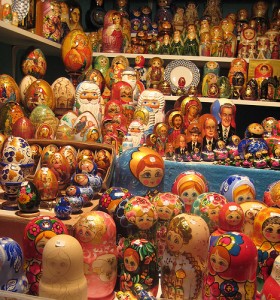 This article sparked a vision of Russian nested dolls – the degree of complexity due to design or chance at every stage of the creation of a functional molecule. It’s huge and we’re still trying to figure it out.
While I won’t even try to quantify the level of complexity introduced at each stage, one can figure out where there might be “complexity inflection” points, where the level of complexity is bumped up an order of magnitude (or a few Venters) with a simple feature.
For example, the Central Dogma (ugh, never liked that term, specifically for what I say in this post) stated that DNA is transcribed into RNA which is translated into Protein. Fine and dandy until you realize that DNA replication (making DNA from DNA) and RNA transcription have copying errors. Already at this stage, one can ask how much this error rate is moderated by thermodynamics, mechanical errors, or evolved into a stable rate that balances evolution and stability). And I even haven’t begun to discuss the complexity introduced from regulatory elements, DNA modification, splicing of RNA, DNA structure, RNA structure, and small regulatory RNAs (one can see the effect of all these complexity inflection points just from comparing prokaryotes and eukaryotes).
So we already have pointed out all those potential complexity inflection points and we haven’t even started making that Protein in the simplistic Central Dogma. And this is stuff we know and have been quantifying.
Let’s continue: Once you start making the protein, there is the error rate of protein translation, which I don’t think folks have properly quantified (though I have seen a paper or two); the speed of translation affecting early modifications of the protein; and, of course, what triggered this post, post-translation modification.
I can go on mapping these complexity inflection points (and maybe I should….). And I think somewhere there is the answer as to why things in life seem to get more complex not simpler.
I’ve been thinking of this on and off for decades (I call it “complexification“). My observations come mostly from biology and I can recommend a great book by EO Wilson that attempts to understand the nesting of complexity and networks within a biological system, where each level reflects the other levels in terms of complexity – Consilience.
What do you think of the role of complexity in biological systems? How do they affect what we make with biology, say, though Synthetic Biology? Do you have any great papers or books on complexity to recommend?
Image from Annie Mole